
Ask a simple question in Indiana, and a simple answer may not follow: “What time is it?”
In most states, one clock covers nearly every daily plan. In Indiana, location matters. A meeting in Indianapolis, a dinner in Evansville, and a work call in Lake County may not all line up on one clock.
Indiana is one of 15 U.S. states split between two time zones. Its split has caused more debate than most because local identity, business ties, state politics, federal rules, and daylight saving habits all became part of the fight.
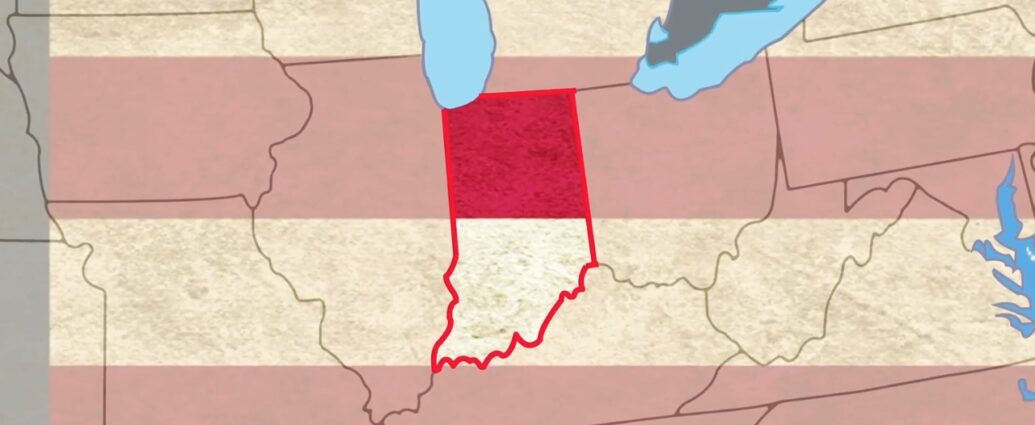
Basic numbers tell part of the story. Indiana has 92 counties. Eighty counties use Eastern Time. Twelve counties use Central Time. Those 12 Central Time counties sit in two separate groups of six.
One group lies in northwest Indiana near Chicago. Another group lies in southwest Indiana near Evansville.
So why does one state need two clocks? Answering that means looking at Indiana not just as a map, but as a set of communities pulled toward different regional centers.
Where are Indiana’s Two Time Zones?
Most of Indiana runs on Eastern Time. Indianapolis, South Bend, Fort Wayne, and much of central and eastern Indiana use that clock.
Central Time appears in two clusters. Northwest Indiana follows Chicago’s clock. Lake County, which includes East Chicago, sits next to Chicago and has long been tied to Chicago media, television, jobs, business, and commuting patterns.
Many people in that corner of northwest Indiana plan their days around Chicago more than Indianapolis. Southwest Indiana has another Central Time cluster around Evansville. Evansville is Indiana’s third-largest city and an economic engine for its region. Nearby areas of Illinois and Kentucky also operate on Central Time, so matching those clocks helps local businesses and daily life. Indiana’s time zone line does not follow geography alone. It follows economic habits, media markets, commuting patterns, and regional loyalties. Many residents work with Chicago, travel to Chicago, follow Chicago television, and treat Chicago as a major nearby hub. Indiana Rep. Earl L. Harris Jr., who represents a Lake County district, described Chicago as the No. 3 market in the country. That kind of pull is hard to ignore. Because Chicago uses Central Time, nearby Indiana counties benefit by sharing its clock. A shared clock makes TV schedules easier to follow. It makes workdays easier to coordinate. It helps commuters, businesses, schools, and families avoid constant conversion. Southwest Indiana has a similar reason for using Central Time. Evansville anchors a major regional economy in that part of the state. Its business connections reach into nearby Central Time communities in Illinois and Kentucky. For many people near Evansville, Central Time fits daily routines better than Eastern Time. A contrast appears elsewhere in Indiana. Indianapolis, Fort Wayne, South Bend, and most other communities use Eastern Time. Downtown South Bend is in the Eastern Time Zone, even though other parts of northern Indiana use Central Time. That split can feel odd on a state map, but it makes more sense when local economic ties are considered. Indiana’s clock rules were not settled in one clean decision. In 1918, national time zones were created by the federal government, and Indiana was placed on Central Time. That arrangement did not last across the entire state. Later changes created the structure people recognize today: Decades of arguments followed. State lawmakers, federal regulators, business groups, local officials, and residents all weighed in. Time became more than a technical question. It became a fight over identity, business needs, school schedules, daylight, and which cities Indiana communities felt closest to. One story shows how heated the subject became. In 1949, lawmakers considered a bill that would keep Indiana on Central Time and outlaw daylight saving time. The passage nearly failed because official time was running out. One lawmaker reportedly reached over a gallery railing and physically stopped the official clock at 9 p.m., breaking it. Passage came after that, but the measure had no real enforcement power and was widely ignored. Indiana time was messy because Indiana itself was divided over what clock best matched daily life. The states that don’t observe Daylight Saving Time—and the ones trying to stay in it permanently: https://t.co/yqoSt7cCQd — TIME (@TIME) October 31, 2025 Indiana’s confusion was never only about Eastern Time versus Central Time. Daylight saving time made everything harder. For many years, most of Indiana did not follow daylight saving time. Central Time counties did follow it. That meant a county’s clock could depend on both its time zone and its seasonal rule. An added complication came near Louisville and Cincinnati. Ten counties near those cities followed Eastern Daylight Time “illegally” because residents and businesses felt more connected to those cities than to Indianapolis. Indiana Chamber of Commerce President Kevin Brinegar joked that nobody stopped them because there were “no time police.” Neighboring communities could end up an hour apart during part of the year. A person could cross a county line and suddenly need to adjust appointments, school plans, deliveries, TV schedules, and work calls. In 2005, Indiana lawmakers voted to make the entire state follow daylight saving time starting in 2006. Passage was dramatic. Indiana’s statewide daylight saving bill passed the state House by a single vote. One representative was believed to have lost his seat after changing his vote, switching “no” to “yes.” Culture added another wrinkle. Indiana has an estimated 63,000 Amish residents, and many Amish communities do not follow daylight saving time. For those communities, legal clock changes do not always control daily routines. College Corner sits on the Ohio-Indiana state line. In April 2005, CBS reported that about 4,000 people lived there, with the state line dividing the town and even the local school. For part of the year, residents dealt with two time systems. Ohio followed Eastern Daylight Time. Indiana historically followed Eastern Standard Time. That meant two sides of one community could operate an hour apart. Union Elementary School made the issue feel almost absurd. An Ohio-Indiana line runs through its 80-year-old gymnasium. Principal Dan Shepherd explained the local joke: a basketball shot could leave the Indiana side at 3 p.m. and land on the Ohio side “an hour later.” Daily life carried the consequences. CBS reported missed doctor’s appointments and botched dinner dates because people had to ask which side’s time applied. A waitress at Tina’s Country Kitchen said one benefit of a single time system would be that people would stop asking if an event was on “Ohio or Indiana time.” College Corner also had a school-building oddity. Two front doors marked the split, one with an Ohio flag and one with an Indiana flag. That town turns an abstract policy issue into something concrete. Time rules affected schools, restaurants, doctors’ offices, volunteer fire departments, bars, and community events. For residents, the question was not theoretical. It was built into daily life. Bills to change Indiana’s time-zone arrangement still appear occasionally. Still, many officials and business leaders see the current system as settled. Kevin Brinegar of the Indiana Chamber of Commerce said the issue is “settled in Indiana” and that the state is “set where we are.” His point was practical. Moving the line would not end complaints. It would simply create new counties unhappy with their clock. Sen. Eric Bassler described Indiana as being in a “challenging geographic position” and predicted the arrangement would not change in his lifetime. That view recognizes a basic problem: Indiana sits between major regional pulls. Chicago influences northwest Indiana. Evansville connects southwest Indiana to nearby Central Time areas. Much of the rest of the state fits Eastern Time. The federal process also makes change complicated. After Indiana approved statewide daylight saving time, the U.S. Department of Transportation held four public hearings in November 2005 on requests by 19 counties to move out of Eastern Time into Central Time. Some hearings lasted up to six hours. Clock rules may sound dry, but those hearings showed how personal the issue had become. Any new line would solve some problems and create others. That is why Indiana’s two-zone system is likely to continue. Indiana has two time zones because different parts of the state look toward different regional economies. Northwest Indiana looks toward Chicago. Southwest Indiana looks toward Evansville and the nearby Central Time areas. Most other Indiana counties use Eastern Time. Indiana’s time-zone map may look confusing, but it grew through more than a century of geography, commerce, politics, daylight-saving disputes, local identity, and practical compromise. Frustrating as it can be, the system is not random. It grew out of how Hoosiers live, work, travel, watch TV, schedule meetings, and connect with nearby cities.
Chicago and Evansville Factor
A Long and Messy History of Indiana Time
Year
Change
1918
Indiana was placed on Central Time under the national time-zone system.
1961
Eastern Indiana moved to Eastern Time.
1969
Most of Indiana shifted to Eastern Time.
1969
Northwest and southwest county groups were placed on Central Time.
Daylight Saving Time Made the Headache Worse
College Corner, a Town Split by Time
Why Indiana’s System Probably Is Not Changing Soon
Summary