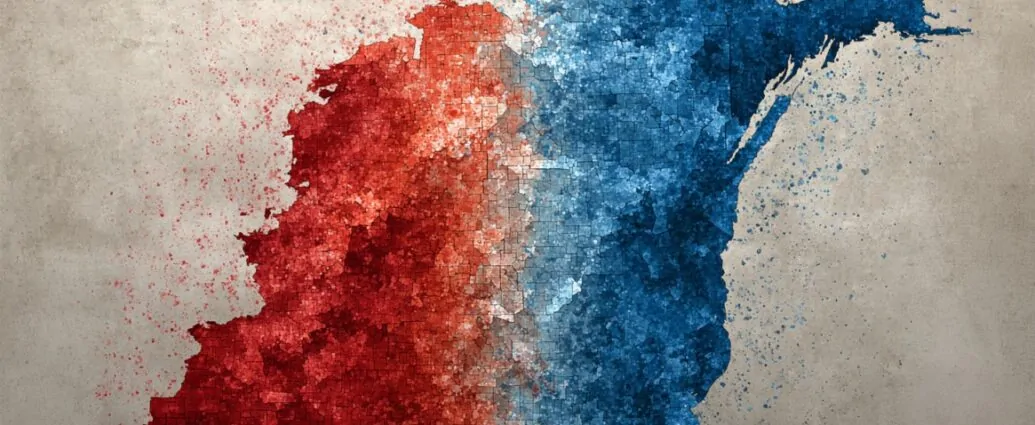
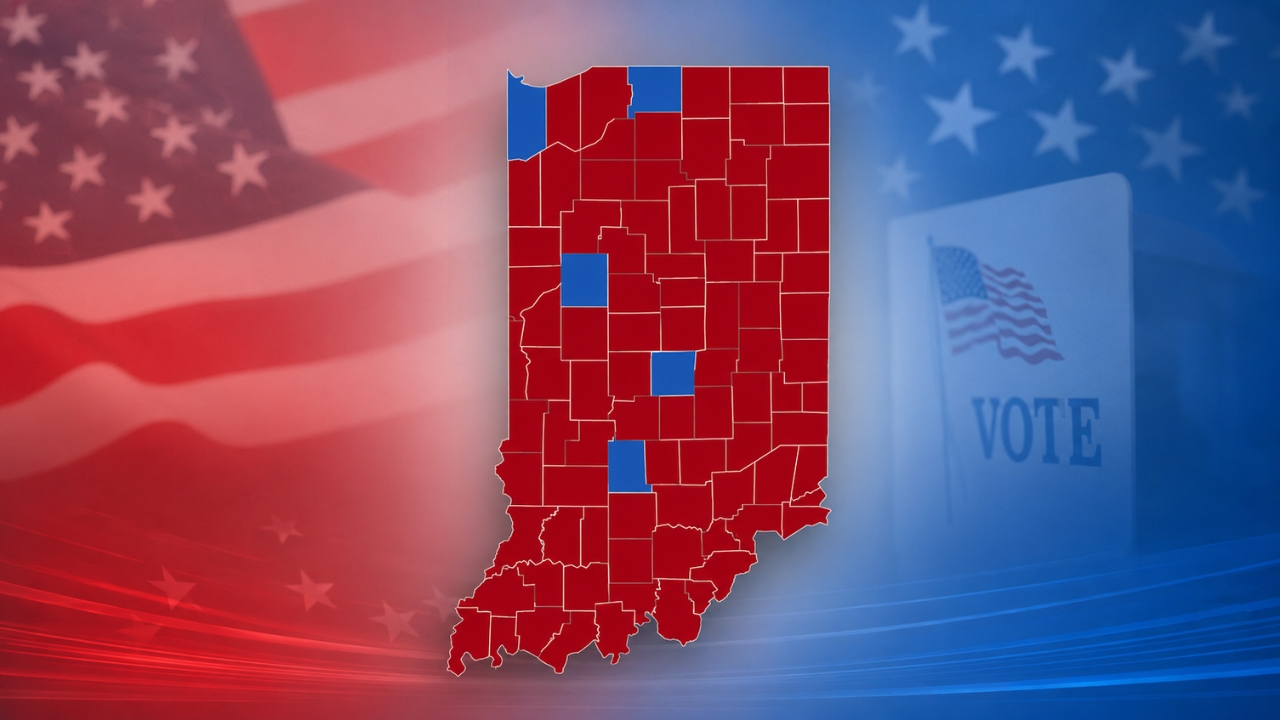
Indiana has clear Republican power at the state level, but voters do not fit into one simple category. GOP control is strong in the legislature, statewide offices, and congressional seats, yet Democratic strength still appears in cities, college towns, suburbs, and urban districts.
Primary fights, crossover voting, mayoral wins, and Trump’s role in state races all show a political picture that is more active and divided than a basic red or blue label suggests.
Indiana is part of a national political environment where Republicans control more state legislatures than Democrats. In 2026, 28 state legislatures are in full Republican control, 18 are in full Democratic control, and 4 have split control.
Across the country, 46 states will hold legislative elections in 2026, covering 88 of the nation’s 99 legislative chambers.
Indiana fits firmly on the Republican side of that national picture. Still, asking “Is Indiana red?” requires more than checking party control. Formal power points to red. Voter behavior, local results, and internal GOP conflict point to a state with serious political tension.
So… Is Indiana Red or Blue?
Factor
What it shows
State control
Republicans control state government and dominate the legislature.
Congressional map
Republicans hold 7 of Indiana’s 9 U.S. House seats.
Redistricting fight
GOP redistricting efforts targeted Democratic-held districts in Gary and Indianapolis.
Republican primaries
Trump-backed candidates won major races, including at least 5 of 7 endorsed state Senate challenges.
Campaign spending
Indiana’s 2026 primary ad spending hit $25.5 million, with Democratic advertisers below 1%.
Democratic strength
Kamala Harris received 40% of the Hoosier vote in 2024, and six cities elected Democratic mayors in 2023.
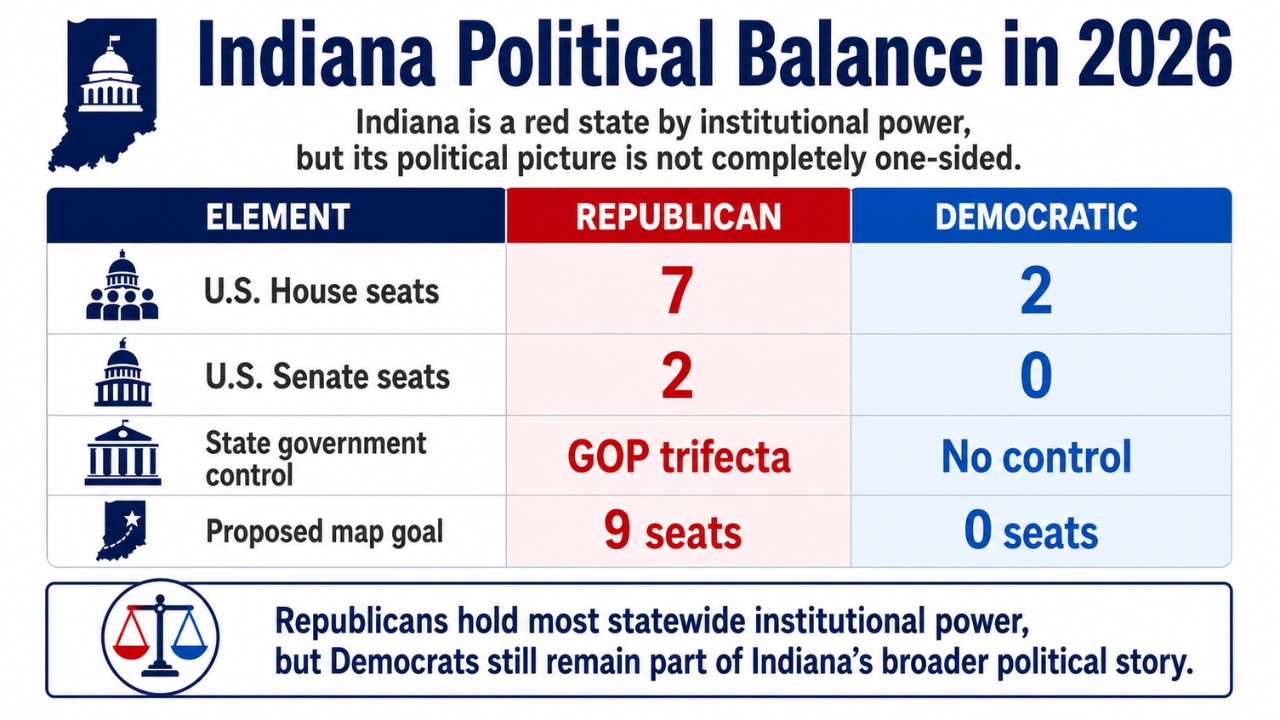
Republicans control the state government and dominate the legislature. Nationally, Indiana fits inside a 2026 picture where:
Congressional control also points red. Republicans hold seven of Indiana’s nine U.S. House seats. Proposed redistricting plans aimed to weaken the two remaining Democratic-held districts in Gary and Indianapolis, showing how much pressure exists to make the map even more Republican. Primary energy also points red. Trump-backed candidates won major Republican primary fights, with at least five of seven Trump-endorsed state Senate challengers winning. That result shows that conservative populism has a strong influence in the Hoosier State. Spending patterns point red, too. Indiana’s 2026 primary ad spending reached $25.5 million, while Democratic advertisers accounted for less than 1% of that total. Most of the major spending battles happened inside the Republican Party, not between the two major parties. Voter behavior adds complexity. Democrats still receive a meaningful statewide vote share. Kamala Harris received 40% in 2024, and six cities elected Democratic mayors in 2023 after replacing Republican incumbents. So, is Indiana red? Yes, by institutions, offices, maps, money, and primary intensity. Is Indiana purely red? No. Democratic voters still matter, local blue pockets still win, and Republican unity is weaker than the top-line party label suggests. Institutionally, Indiana is red. Republicans control the major levers of state government in the Hoosier State. GOP power has been durable, not temporary. That means Republican control of the state House, state Senate, and governorship has been the normal pattern across much of modern Indiana politics. Democrats have also been locked out of some major power centers for decades. A full generation of voters has grown up with Republican control as the expected political order in state government. Statewide leadership has followed a similar pattern. Indiana has not recently operated as a state where Democrats regularly win the governorship or control the legislature. For many Hoosiers, Republican government is not an exception. It is the basic structure of state politics. Democrats have shown they can still compete in parts of the Hoosier State. Barack Obama carried Indiana in 2008, marking the first Democratic presidential win there in 44 years. That result did not turn Indiana into a blue state, but it proved that the state can move in a competitive direction during the right political moment. Local elections also show real Democratic strength. In the 2023 off-year elections, six Indiana cities representing about 300,000 Hoosiers elected Democratic mayors who replaced Republican incumbents. Those victories matter because they show that Democrats can still win executive power at the local level, especially in cities and communities less aligned with statewide Republican trends. Statewide Democratic support also has not disappeared, as we’ve previously said. That level of support is close to the Democratic statewide average in Indiana since 2012. A party that regularly receives around 40% of the vote is not absent, even when it usually loses. Indiana’s red identity is real, but Democratic voters are still a significant minority. Their influence is concentrated, often urban, and sometimes local rather than statewide. That makes the Hoosier State red by power, but not empty of blue voters. In the 2024 primaries, about 180,000 Democratic Senate primary votes were cast, compared with about 600,000 Republican gubernatorial primary votes. Democrats received only 23% of the primary vote, far below their usual general-election share in the state. That gap matters, but Democratic primary participation was much weaker. So, primary turnout may make Indiana look more Republican than general-election behavior suggests. Some Democratic voters may choose Republican primary ballots for practical reasons. Some want to block a more extreme Republican. Others may want a more extreme Republican to win because they think that candidate will be weaker in November. Some see Democratic primaries as uncontested and decide their vote matters more in a Republican race. That behavior can weaken Democratic turnout signals. Parties, donors, and possible candidates pay attention to primary turnout when deciding where to invest. So, asking “Is Indiana red or blue?” based only on primary numbers can be misleading. Republican dominance is real, but Democratic organization may look weaker than Democratic voter support actually is. A major 2026 development in Indiana politics is the success of Trump-backed Republican challengers. A majority of Indiana Republican legislators challenged by Trump-supported opponents lost their primaries after those lawmakers rejected Trump’s redistricting plan. Among seven Trump-endorsed challengers to state Senate candidates, at least five won. Those results showed that Trump’s influence inside the Hoosier State Republican Party is powerful and immediate. Indiana Senate Republicans who opposed congressional redistricting were largely defeated during the Tuesday primary election, with only one race called for an incumbent at the time of publication. Trump had publicly called for opponents of redistricting to be defeated, saying Republicans who voted against redrawing Indiana’s congressional boundaries should be “PRIMARIED.” One major Indiana Republican figure said the results showed Trump is “the single most popular Republican among Hoosier voters.” That statement captures the central meaning of the 2026 primary fights. Republican voters were not only choosing candidates. They were also judging loyalty to Trump. It is increasingly shaped by MAGA-aligned Republican politics. In 2026, the key political question in Indiana may not be red or blue. It may be which kind of red controls the GOP. Trump pushed Indiana Republicans to redraw congressional districts in a way that would favor the GOP. Republicans currently hold seven of Indiana’s nine U.S. House seats. A proposed map targeted the two remaining Democratic strongholds, Indiana’s 1st and 7th congressional districts. Those districts include the urban centers of Gary and Indianapolis. Indiana Senate Republicans rejected the redistricting bill by a 31 to 19 vote, joining Senate Democrats to stop the proposal. That vote created a major split inside the Indiana Republican Party. Trump’s pressure in Indiana was part of a broader national push to protect Republican control of the U.S. House by redrawing congressional maps. In the Hoosier State, however, the fight became personal and expensive. An estimated $9 million was spent to support primary challengers against incumbents who opposed redistricting. Trump-aligned dark-money groups spent more than $7 million on TV ads in Indiana, with most of that spending aimed at Republicans who joined Democrats in the December redistricting vote. Primary ad spending in Indiana reached $25.5 million. Democratic advertisers made up less than 1% of that total, which shows that the biggest money fight was not between Republicans and Democrats. It was inside the Republican Party. Redistricting also split major Republican leaders. Senate President Pro Tem Rodric Bray was on one side of the fight, while more Trump-aligned figures such as Gov. Mike Braun and Lt. Gov. Micah Beckwith were on another. Democratic voters still make up a meaningful share of the electorate. During presidential elections, Democrats received only 23% of the primary vote. That contrast suggests Democrats may have a visibility and organization problem more than a total voter absence problem. Low Democratic primary turnout can create a damaging cycle. Democrats skip primaries because races are uncontested. Races stay uncontested because Democrats do not show visible turnout. Parties, donors, and possible candidates then see less reason to invest. Breaking that cycle would require Democratic voters to participate in their own primaries more consistently. Primary turnout sends a signal. Stronger turnout can make districts look more competitive, encourage better candidates, and attract outside support. Democratic opportunity is strongest in cities, college towns, suburbs, and districts affected by Republican infighting. Local elections already show that Democrats can win in the right places. In 2023, six Indiana cities representing about 300,000 Hoosiers elected Democratic mayors who replaced Republican incumbents. Democrats are unlikely to control Indiana statewide in 2026. Still, they can build power by treating every primary and local race as part of a longer organizing effort. A Republican victory may be likely in many statewide contests, but treating it as automatic only makes Democratic weakness worse. Formal political power in the Hoosier State is Republican. GOP strength appears in long-term trifecta control, legislative dominance, congressional seats, and Trump-backed primary victories. Republicans have controlled Indiana’s state government trifecta for 18 of the last 25 years. However, Indiana contains more political tension than the red-state label captures. Democrats still take around 40% of the statewide vote in recent cycles. Six Indiana cities representing about 300,000 Hoosiers elected Democratic mayors in 2023. Urban Democratic strongholds in Gary and Indianapolis still matter. Open-primary behavior may also hide some Democratic strength by pulling Democratic voters into Republican primaries.
Indiana’s Political Baseline – A Republican-Dominated State

Indiana Is Not Politically Monolithic
Primary Voting and Why Democratic Strength Can Look Weaker
Trump’s Influence and 2026 Republican Primary Battles
Redistricting as a Test of Power
Meaning for Democrats in 2026
Closing Thoughts