
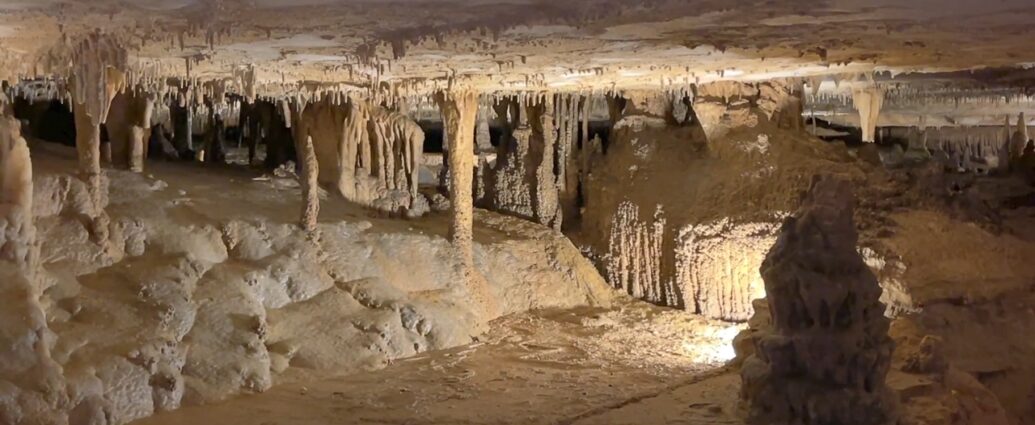
Southern Indiana looks quiet at first glance. Rolling hills, wooded ridges, rural roads, and small towns shape much of its surface.
Yet below that calm ground is limestone country, where water has spent thousands of years cutting passages through stone. This is the hidden world of underground Indiana, a place where rivers, chambers, waterfalls, and mineral formations sit beneath forests, farms, hillsides, and sinkholes.
More than 2,600 caves are believed to sit beneath a small wedge-shaped region of Southern Indiana.
Some are known only to trained cavers, while others have become guided attractions where visitors can safely enter a darker, older part of the state.
The Indiana Cave Trail
The Indiana Cave Trail brings together several of Southern Indiana’s best-known show caves into a single road trip.
Instead of seeing caves as isolated attractions, visitors can follow the trail across limestone country and compare different parts of underground Indiana in one region.
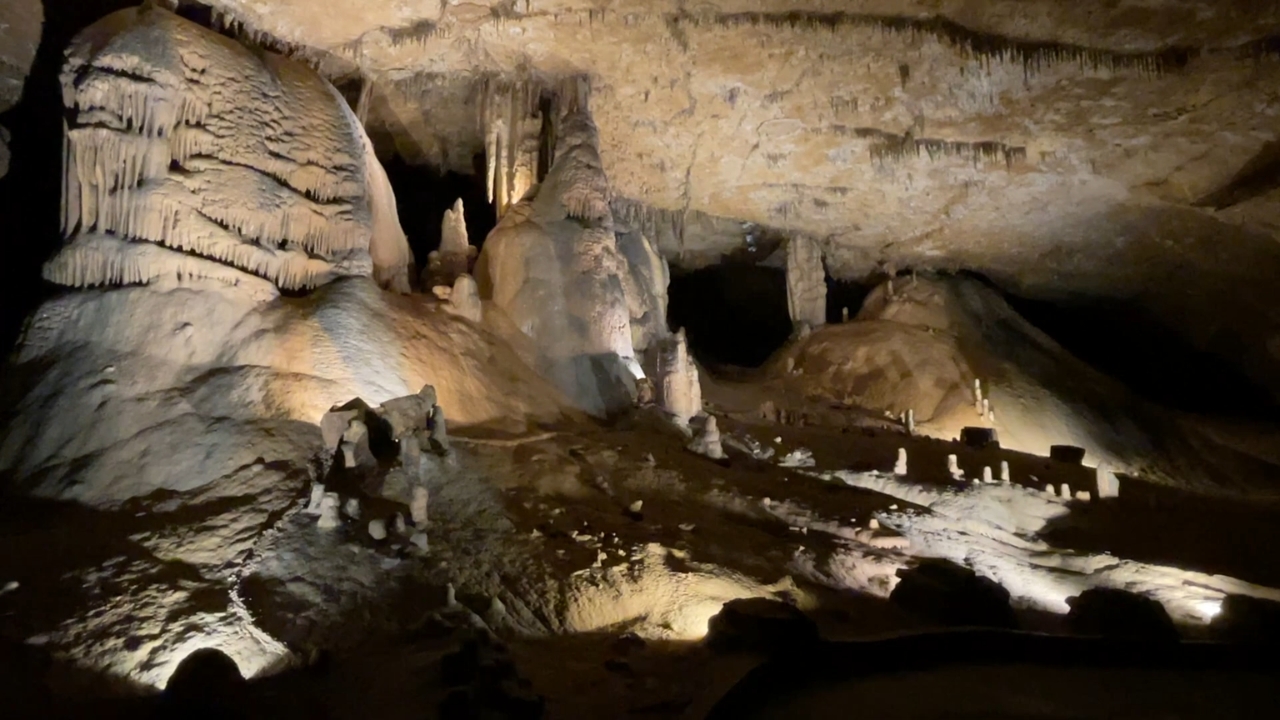
Each cave shows a different side of underground Indiana. Bluespring Caverns is centered on an underground river. Marengo Cave is known for historic walking tours and dense formations. Squire Boone Caverns has waterfalls, stairs, rimstone pools, and a strong connection to frontier history. Indiana Caverns adds a more physical style of underground travel, including boat sections and adventure routes tied to the larger Binkley Cave System. Together, these stops show why Southern Indiana is one of the state’s most important cave regions. Visitors can move between river passages, decorated chambers, steep stairways, sinkhole entrances, historic rooms, and cave wildlife without leaving the hills of Southern Indiana. Underground Indiana is not defined by one type of cave experience. Some caves are shaped around rivers and boat rides, while others are known for mineral formations, historic rooms, waterfalls, or physical adventure routes. Looking at the major stops together shows how varied Southern Indiana’s underground world can be. Instead of walking past large rooms filled mainly with dripstone formations, visitors move by boat through a cave shaped heavily by flowing water. Myst’ry River runs through Bluespring Caverns. One account describes it as a 21-mile subterranean river and calls it the longest subterranean river in the United States. Tour boats are specially designed 17-person flat-bottomed boats built for the cave’s narrow underground water route. Bluespring Caverns feels less like a decorated room and more like a living cave system. Water is still present, still moving, and still shaping the passages. Visitors see how an underground river can carve its own route through limestone, leaving behind a dark, wet, echoing world far below the hills. As part of underground Indiana, Bluespring Caverns stands out because the river is not just a background feature. It is the main reason the cave feels alive. Marengo Cave is one of Indiana’s most famous caves and one of the major stops on the Indiana Cave Trail. Located in the knobs of Southern Indiana, it sits among rolling hills and sandstone cliffs. It is a registered U.S. National Natural Landmark and has been tied to tourism, local history, and underground discovery for well over a century. Discovery came in September 1883, when two young siblings entered the cave. Marengo quickly became an attraction, and the Marengo Cave Company was created in 1900. Early visitors came to see the cave’s unusual formations, large rooms, and natural passageways, and traces of that early tourism are still part of its story. Marengo Cave is packed with formations and named features. Calcite flowers add delicate mineral detail. Stalagmites in one area have been compared to Sherwood Forest. A rimstone dam resembles the Great Wall of China. Crystal Springs, Prison Bars, Mirror Lake, and the Penny Ceiling all add to the cave’s long list of memorable stops. Human history gives Marengo Cave extra depth. Old drinking cups used during early cave tours can still be seen near Crystal Springs. Penny Ceiling became known as an upside-down wishing well because coins stuck to the ceiling. Squire Boone Caverns is known for water, vertical movement, and dramatic underground passages. Stairs, catwalks, rushing water, rimstone pools, narrow routes, and crevices all shape the visit. Compared with a simple walking cave, Squire Boone Caverns feels more physically connected to the moving water that helped create it. Frontier history is central to the cave’s identity. Squire Boone, brother of Daniel Boone, discovered the cave in the late 1700s. He later built a gristmill powered by water coming out of the cave. That connection between underground water and early settlement gives the site a strong historical layer. Cave tours opened in 1972, giving visitors access to passages tied to both geology and the Boone family history. Visitors enter by descending a 62-foot spiral staircase. Once below ground, the route crosses catwalks and stairs above active water. A waterfall runs beneath the walkway, adding sound and movement to the cave setting. Squire Boone Caverns connects natural formations with human memory. Water carved the passages, powered a mill, and still moves through the cave today. At the same time, Boone’s burial site inside the cave ties the underground space to Indiana’s frontier past. This stop adds another layer to underground Indiana because it connects moving water, cave formation, frontier settlement, and personal history in one place. Southern Indiana’s wooded hills hide far more than they show. Beneath the surface are rivers, chambers, waterfalls, stone formations, historic gathering places, cave wildlife, and passages still being shaped by water. Caves along the Indiana Cave Trail make underground Indiana feel older and more mysterious than the land above it. A road through quiet limestone country can lead to a sinkhole entrance, a dark river, a spiral staircase, a crystal-filled chamber, or a kayak route far below the surface. Below Southern Indiana, water and stone are still at work. That hidden world is what makes underground Indiana so powerful to visit.Major Cave Stops
Bluespring Caverns
Bluespring Caverns is best known for its underground river experience. Visitors begin by descending a steep path into a sinkhole before boarding a boat on the dark water below.
Marengo Cave
Squire Boone Caverns
Summary