Violent crime in the United States increased sharply during the COVID-19 pandemic, especially during 2020 and 2021. Many major cities experienced a surge in homicides during that period.
Law enforcement agencies and local governments faced serious challenges as economic instability, social disruption, and strained public resources contributed to rising violence.
Indianapolis experienced a similar pattern. Murder totals climbed rapidly and reached a record 241 homicides in 2021, the highest number ever recorded in the city. Such a surge placed Indianapolis among the cities with the highest homicide rates in the country.
By 2025, the number of homicides dropped to approximately 133 cases. Such a change represents a decrease of about 45% over four years.
Therefore, it is interesting to take a look at the Indianapolis crime rate and everything that surrounds that topic.
Decline in Homicides and Violent Crime in Indianapolis
Indianapolis crime rate increased during 2020 and 2021, placing heavy pressure on law enforcement agencies and community organizations. Some even say that the trends can lead it to being equally dangerous as Gary, Indiana.
Homicide numbers reached levels never recorded before in the city. Local officials, police leaders, and residents expressed growing concern as violence escalated during those years.
Recent years have brought measurable improvement in Indianapolis crime statistics. Declines in murders and other violent offenses suggest progress after the historic surge. Law enforcement strategies, community intervention programs, and broader national crime patterns contributed to those changes.
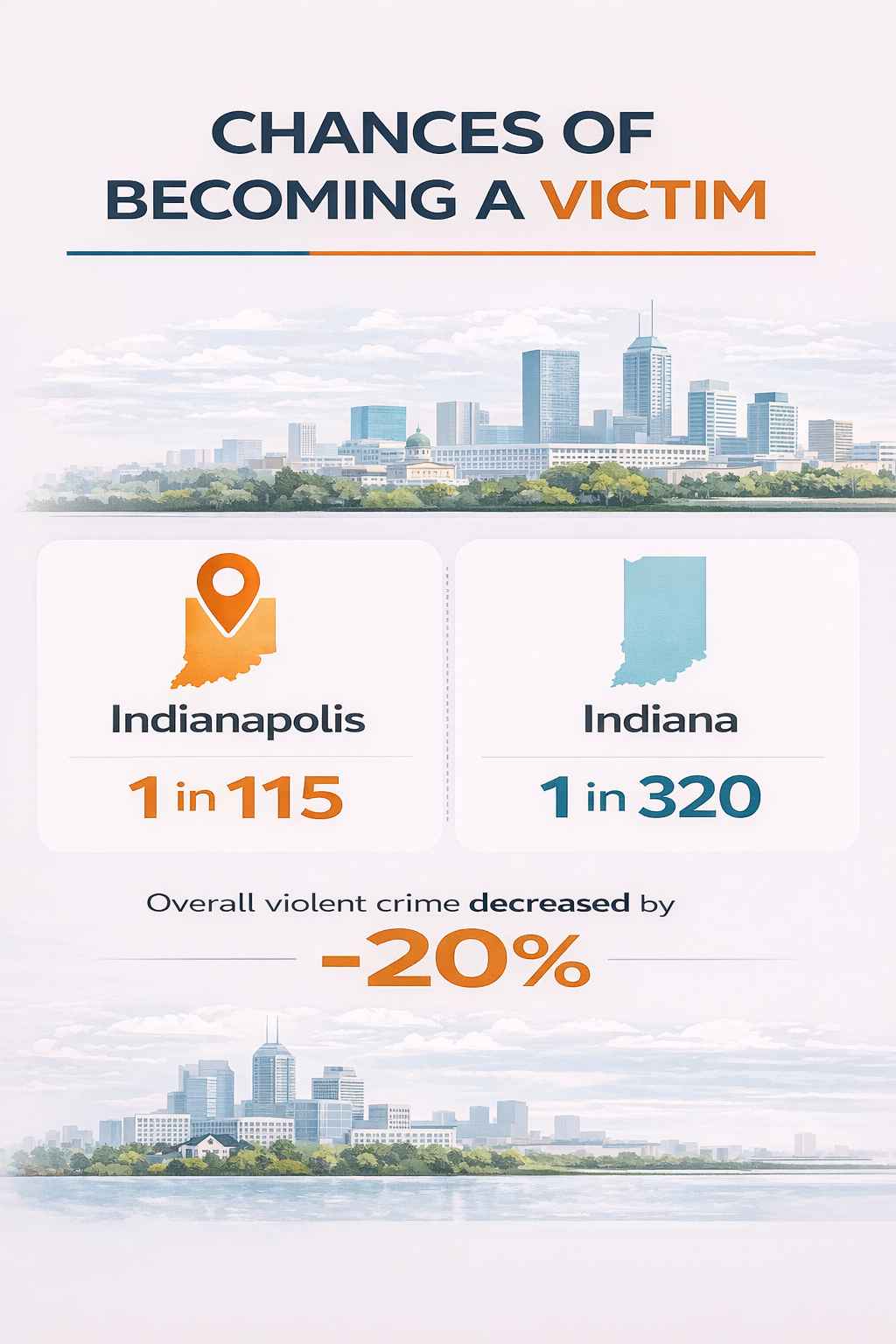
Thankfully, according to NeighborhoodScout, the current Indianapolis crime rate is 41.50 per 1000 population after all the action taken by the local police force.
- Indianapolis – 1 in 115
- Indiana – 1 in 320
Record Highs Followed by Significant Declines
Indianapolis crime rate reached a critical point in 2021 when the city recorded 241 murders. That figure marked the highest homicide total in local history. Rapid increases during pandemic years placed Indianapolis among cities with the highest levels of violence in the country.
Public safety concerns increased across many neighborhoods during that period. Police departments faced pressure to respond to rising gun violence while also dealing with staffing shortages and increased service calls.
Homicide numbers began declining after the 2021 peak. Yearly totals gradually decreased as law enforcement agencies expanded targeted enforcement efforts and community organizations increased outreach activities. By 2025, homicide totals dropped significantly.
Recent data shows the scale of that improvement. Murder totals decreased to approximately 133 cases in 2025. That shift represents a reduction of about 45% compared with the 2021 peak.
Several reports also provide additional details about homicide victims during the same year. Victim demographics and causes of death provide insight into Indianapolis crime patterns.
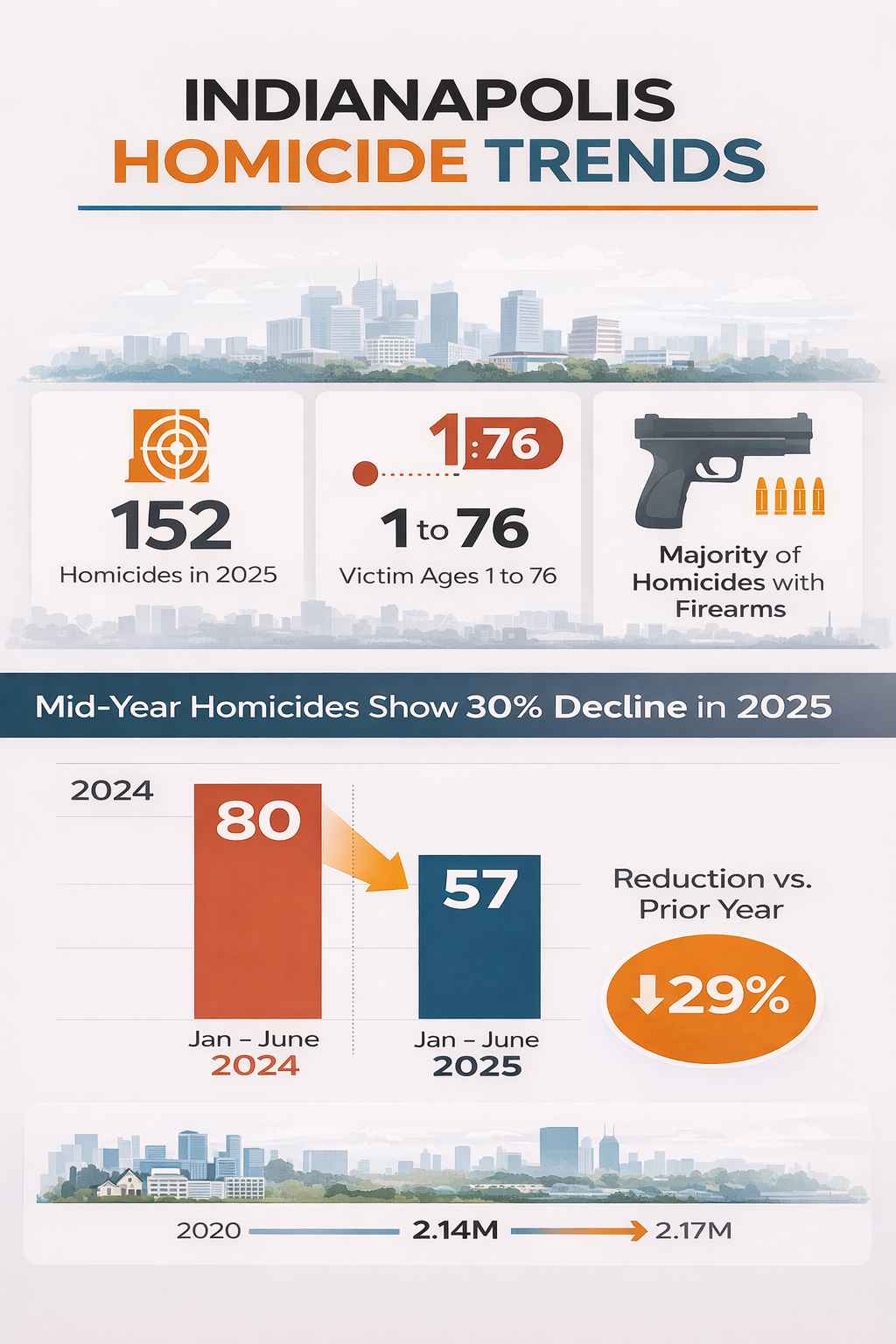
- Some reports list 152 homicides recorded during 2025
- Victim ages ranged between 1 year old and 76 years old
- Firearms accounted for the majority of deaths in homicide investigations
Gun violence remains the dominant factor in Indianapolis crime involving homicide cases. Police reports consistently show that firearms play a role in most murders across the city.
Mid-year data during 2025 provided additional signs of improvement. Police statistics revealed lower homicide totals during the first half of the year compared with the previous year.
- 57 homicides occurred between January and June 2025
- 80 homicides occurred during the same period in 2024
- Reduction during that timeframe reached nearly 30%
Such results indicate that Indianapolis crime involving homicide has decreased significantly since the peak years of the pandemic. Continued monitoring remains necessary because crime patterns can change depending on social conditions, economic factors, and enforcement priorities.
Long-term reductions in violence will depend on sustained cooperation between law enforcement agencies, community programs, and local government initiatives.
Reductions Across Other Violent Crime Categories
Improvements in Indianapolis crime statistics extend beyond homicide totals. Police records show declines in several categories of violent offenses during recent years. Falling numbers in those areas indicate broader improvements in public safety conditions.
Nonfatal shootings decreased alongside falling homicide totals. Robbery incidents also declined during the same period. Police agencies attribute part of that improvement to targeted enforcement strategies and improved crime analysis.
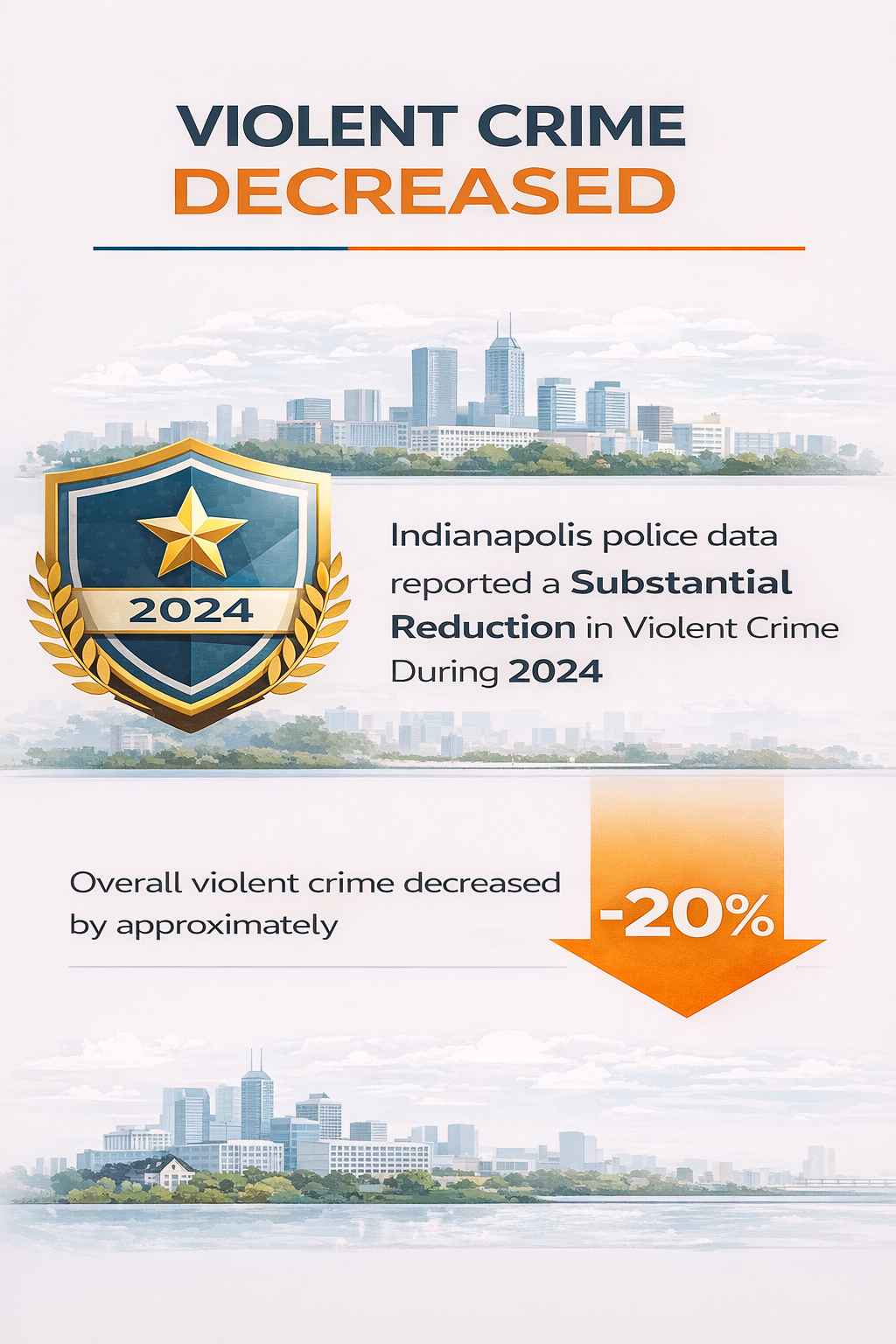
Indianapolis police data reported a substantial reduction in violent crime during 2024. Overall, violent crime decreased by approximately 20% during that year.
Such reductions demonstrate that improvements in Indianapolis crime trends extend across multiple categories rather than being limited to homicide cases.
National crime data also supports the progress observed in Indianapolis. Year-over-year comparisons show that homicide totals in the city declined significantly compared with earlier years.
Lower levels of shootings, assaults, and robberies indicate coordinated efforts by law enforcement agencies, community organizations, and local government leaders. Continued progress in those areas may contribute to further reductions in Indianapolis crime in future years.
Policing Strategies Behind the Decline
Falling violence levels in Indianapolis crime statistics did not occur by chance.
Law enforcement agencies introduced several approaches designed to reduce shootings, robberies, and other serious offenses. Police leaders adopted focused tactics aimed at the individuals and locations most closely linked to violent incidents.
Community partnerships also played a role in addressing violence. Local organizations, outreach workers, and government agencies worked together in order to prevent conflicts and assist residents affected by crime.
Targeted, Data-Driven Policing
Indianapolis Metropolitan Police Department leadership placed strong attention on crime patterns linked to specific individuals and locations.
Data analysis became a central part of crime prevention efforts.
Investigators and analysts reviewed incident reports, arrest records, and intelligence information in order to identify recurring patterns in Indianapolis crime.
Police leaders explained that many violent offenses involve a relatively small group of individuals.
Concentrating enforcement resources on those individuals and locations allows officers to intervene more effectively. Crime analysts identified high-risk areas across the city where shootings and robberies occurred most frequently.
Such methods aimed to interrupt cycles of retaliation that often follow shootings.
Preventing additional incidents after an initial act of violence remains an important component of reducing Indianapolis crime.
Law enforcement officials also monitored locations with repeated disturbances or criminal activity. Officers worked closely with community leaders in order to address safety concerns in those neighborhoods.
Leadership Changes and Enforcement Focus
Leadership changes within the Indianapolis Metropolitan Police Department also influenced enforcement priorities. Chris Bailey became police chief in February 2024.
New leadership introduced a renewed focus on reducing violent crime while improving communication with residents. Public safety remained the department’s primary objective during Bailey’s leadership.
Community interaction increased as officers engaged more frequently with neighborhood groups, business owners, and local organizations.
Police leaders encouraged officers to build stronger relationships with residents affected by Indianapolis crime.
- Reduction of gun violence and homicide cases
- Increased communication between officers and neighborhood organizations
- Continued monitoring of repeat offenders linked to violent activity
Officer training and investigative resources also received attention during leadership changes. Police officials sought improvements in investigative technology and case coordination across agencies.
Maintaining focus on individuals responsible for violent incidents remained central to the department’s approach to reducing Indianapolis crime.
Crime Reduction Initiatives
Multiple programs contributed to reductions in violent crime across Indianapolis. Partnerships with state and federal agencies expanded during recent years in order to address illegal firearms and organized criminal activity.
The Indiana Crime Guns Task Force played a significant role in investigations involving firearm trafficking and violent offenses. Joint investigations helped remove illegal weapons linked to shootings and robberies.
Law enforcement cooperation across agencies strengthened efforts to reduce Indianapolis crime. Investigators shared information and resources during operations targeting individuals involved in gun-related offenses.
Technological improvements also enhanced policing operations. Expanded data systems allowed officers to track incidents more efficiently and identify crime patterns across neighborhoods.
- Expanded crime data systems are used for identifying patterns in shootings and robberies
- Coordinated investigations involving state and federal agencies
- Enhanced communication between investigative units
Mental health response programs also expanded across the city. Specialized response teams handled incidents involving individuals experiencing psychological distress. Such responses aimed to reduce situations that might escalate into violence.
City officials also directed federal pandemic relief funds toward prevention programs. Many of those programs focused on youth outreach and intervention efforts targeting individuals considered at risk of involvement in Indianapolis crime.
Community Violence Prevention Programs
View this post on Instagram
Community-based initiatives play an important role in reducing violence across Indianapolis. Outreach organizations work directly with residents affected by shootings and other violent incidents.
Indy Peace remains one of the most visible programs addressing Indianapolis crime at the community level.
Program staff focus on violence interruption, mentorship, and conflict mediation.
Outreach workers establish relationships with individuals who face a higher risk of involvement in violent incidents.
Those individuals often include young people exposed to crime within their neighborhoods.
- Direct outreach to individuals involved in conflicts following violent incidents
- Mentorship programs designed to guide young residents away from criminal activity
- Mediation efforts aimed at preventing retaliation after shootings
Outreach workers also assist families affected by violence by connecting them with support services. Counseling and social assistance programs help residents cope with trauma related to Indianapolis crime.
Federal pandemic relief funds supported the expansion of such programs during recent years. Local organizations partnered with city officials in order to increase the reach of violence prevention efforts.
Collaboration between community groups and law enforcement agencies helped reduce tensions in neighborhoods experiencing frequent incidents of gun violence.
The Bottom Line
Indianapolis experienced a dramatic decline in homicides after reaching a record 241 murders in 2021. Murder totals dropped to about 133 cases by 2025, representing a reduction of close to 45% during that period.
Lower homicide numbers occurred alongside decreases in shootings, robberies, and aggravated assaults.
Crime levels across the city remain higher than national averages in several categories. Continued efforts by law enforcement, community organizations, and local government remain necessary to sustain progress.
Sources
- NeighborhoodScout – Indianapolis, IN Crime Rates
- WFYI – Indianapolis violent crime drops from 2021 peak, reports IMPD
- IndyStar – Indianapolis violent crime in 2025 ticked down, police data shows
- WRTV – ‘We’re going to keep working’: Indianapolis homicides decline in 2025
- The Trace – In Indianapolis, Drugs and Guns Converge, but Solutions Remain Disjointed
- Axios – Homicides, other violent crime down in Indianapolis this year
- IBJ – Hogsett taps police chief Chris Bailey as new chief of staff
- PoliceForum – A few recent developments about gun regulation and policy
- Justia Law – 2025 Indiana Code Title 36. Local Government Indiana Crime Guns Task Force Established