Indiana has never chased the movie-capital label, yet the state keeps showing up in American film history anyway. Part of the appeal is obvious once you look at the places that have made it on screen: old gyms with real hardwood history, college-town streets that feel lived in, ballparks with deep roots, racing landmarks, and small cities that still carry a strong visual identity.
From Bloomington and South Bend to Huntingburg, Knightstown, Indianapolis, Columbus, Crown Point, Frankfort, and French Lick, Indiana has given filmmakers settings that already feel like a story before a camera even rolls.
A lot of people mix up movies set in Indiana with movies actually filmed there. A Christmas Story is the classic example. It is rooted in Hammond, but production happened mainly in Ohio, so it does not belong on a straight Indiana filming list.
Today, we prepared a full list of the best-known feature films and high-profile productions with documented Indiana filming locations. Let’s get right into it.
Quick List of Famous Movies Filmed in Indiana
| Movie | Release Year | Main Indiana Filming Locations | Why It Matters |
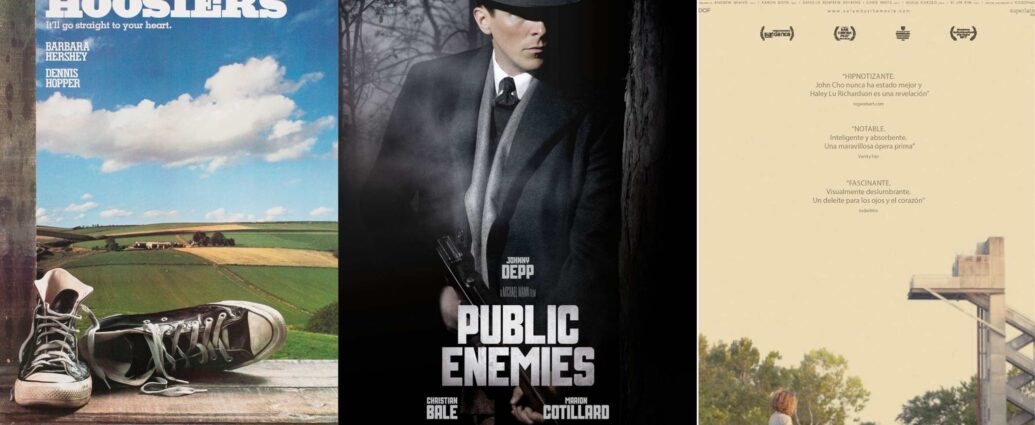
| Hoosiers | 1986 | Knightstown, Indianapolis, New Richmond | Indiana basketball myth on film |
| Breaking Away | 1979 | Bloomington, Indiana University area | Bloomington and Little 500 culture |
| Rudy | 1993 | Notre Dame, South Bend | Notre Dame sports icon |
| A League of Their Own | 1992 | Huntingburg, Evansville | Indiana baseball landmarks on screen |
| Public Enemies | 2009 | Crown Point | Real Dillinger history and real jail site |
| Columbus | 2017 | Columbus | Architecture-centered modern indie |
| Blue Chips | 1994 | Frankfort, French Lick | College basketball drama with Indiana texture |
| Hard Rain | 1998 | Huntingburg | Action thriller built around an Indiana town |
| Eight Men Out | 1988 | Indianapolis | Vintage baseball look from old Bush Stadium |
| Soul of the Game | 1996 | Huntingburg | Negro League story tied to League Stadium |
| Going All the Way | 1997 | Indianapolis | Postwar Indianapolis as character and setting |
| Winning | 1969 | Indianapolis Motor Speedway | Racing drama tied to Indy 500 footage |
1. Hoosiers (1986)
No movie is more closely tied to Indiana screen identity than the Hollywood movie Hoosiers. For a lot of viewers, it remains the state’s defining sports film because it captures the small-gym intensity and local pride that shaped high school basketball culture for generations.
Knightstown’s Hoosier Gym served as the Hickory Huskers’ home court, while the climactic state championship scenes were filmed at Hinkle Fieldhouse in Indianapolis. Get Indiana and Butler still point fans to both places today.
What makes the film endure is not only the underdog story. Location choice did a huge share of the work. Knightstown was already a real 1921 gymnasium with decades of community basketball behind it, which gave the movie a texture no soundstage could fake.
Hinkle added the grander statewide stage that Indiana basketball needed. A sports drama could have been filmed anywhere. A film about Indiana basketball had to feel like Indiana, and Hoosiers did.
2. Breaking Away (1979)
Breaking Away may be the purest Bloomington movie ever made. Indiana University library material still describes it as the Little 500 movie, and Bloomington’s tourism guide continues to map out recognizable filming spots like the Indiana Memorial Union and the Rose Well House on campus.
That local grounding matters because the movie is about far more than bikes. It is about class, town-versus-gown tension, post-high-school drift, and the odd pride of growing up in a place outsiders rarely fully see.
Bloomington gives the film its pulse. The quarries, campus corners, and neighborhood feel keep the story from floating into generic coming-of-age territory. Even decades later, the movie still feels welded to southern Indiana limestone country.
3. Rudy (1993)
Few sports movies have a stronger geographic bond than Rudy. Notre Dame’s own archival material notes that the film was shot on campus over several weeks, with the famous final scene filmed during halftime of the 1992 Notre Dame versus Boston College game.
The Joyce Center also hosted several scenes, including training-room moments and the sequence where Rudy learns he made the team.
South Bend gives the movie a built-in emotional frame. Notre Dame Stadium, the campus landmarks, and the wider aura around the program already carry national meaning, so the film never has to invent grandeur. It simply taps into a place that already has it.
For Indiana film history, Rudy matters because it shows how a real campus can carry a sports legend without losing the rough edges that made the story resonate in the first place.
4. A League of Their Own (1992)
Huntingburg’s League Stadium is one of the great Indiana movie landmarks. The city’s official pages state that Columbia Pictures renovated and expanded the original field and grandstand in 1991 for A League of Their Own, using the ballpark as the Rockford Peaches’ home field. Original advertisements from the movie still remain along the outfield fence.
Indiana fit the film perfectly because the state still had old baseball spaces that looked right on camera without feeling preserved into lifelessness.
Huntingburg and Evansville helped create a believable wartime baseball world, and Penny Marshall’s movie has kept League Stadium in public memory ever since.
Among Indiana filming stories, one of the most useful details is practical: you can still go see the place and immediately recognize why filmmakers chose it.
5. Public Enemies (2009)
Michael Mann’s Public Enemies brought Indiana into a different register entirely. Parts of the film were shot in Crown Point, the town where John Dillinger was jailed and escaped, and the production used the old Lake County jail tied to the real event.
That connection appears both in film-location reporting and production summaries of the movie. PBS’s Dillinger timeline also marks Crown Point as a key stop in the real story.
That link between real criminal history and filming location gives the movie unusual weight. Crown Point is not serving as a vague stand-in. It is part of the actual Dillinger map.
For readers who like location-driven film history, Public Enemies is one of the clearest examples of Indiana offering more than scenery. Indiana offered historical ground the movie could literally stand on.
6. Columbus (2017)
If Hoosiers is Indiana’s classic sports movie, Columbus is one of its most visually distinctive modern films. Visit Columbus states that Kogonada’s 2017 film was filmed entirely in Columbus, Indiana, and turned the city’s modernist buildings into co-stars.
That description is accurate. Architecture does not sit in the background in Columbus. It shapes the pace, mood, and silence of the film. Columbus had long been admired by design people, but the movie gave a broader audience a reason to notice why the city matters.
For Indiana’s screen history, that is a major shift. A state often associated on film with sports and small towns also produced a quiet, internationally admired drama anchored by design and urban form.
7. Blue Chips (1994)
Blue Chips is another Indiana basketball entry, though its tone is more cynical than Hoosiers. Search records for filming locations point to Frankfort Senior High School and French Lick as Indiana production sites, and French Lick Resort has also looked back on how the movie brought stars, extras, and basketball names into town during production.
Indiana works well here for obvious reasons. Even a story about recruiting corruption and program pressure benefits from basketball terrain that feels real.
Frankfort gave the production a convincing arena interior, while French Lick added a layer of local basketball mythology of its own. Anyone who knows the state’s relationship with the sport can see why filmmakers kept coming back to Indiana whenever a script needed hoops credibility.
8. Hard Rain (1998)
Huntingburg also hosted Hard Rain, a very different production from A League of Their Own. The city’s tourism pages still mention the film alongside Huntingburg’s better-known baseball titles, and production summaries identify Huntingburg as a filming location for the movie.
What makes Hard Rain interesting in an Indiana roundup is the sheer contrast. Huntingburg was flexible enough to play nostalgic baseball in one film and flooded-action chaos in another.
Even with heavy set work and studio support elsewhere, the Indiana town gave the movie its core identity. For readers trying to gauge Indiana’s range as a filming state, Hard Rain is useful proof that not every Hoosier production leaned on sentiment or Americana.
9. Eight Men Out (1988)
Baseball and Indiana come together again in Eight Men Out. Reporting on Indianapolis film history notes that much of the filming took place at old Bush Stadium and other downtown locations, while Visit Indiana adds that some interior shots were filmed at the Athenaeum. Search records for filming locations also identify Bush Stadium as a major site.
Bush Stadium gave the movie something hard to fake: a period baseball setting with enough age and wear to sell 1919. Indianapolis helped the film look right without drowning it in polished nostalgia.
That matters because Eight Men Out is a baseball movie about corruption, money, class, and moral rot. The city’s older spaces match the mood better than a cleaner modern backdrop ever could.
10. Soul of the Game (1996)
Soul of the Game deserves a place on the list even though it was an HBO film rather than a theatrical release. Huntingburg’s official League Stadium pages state plainly that the movie was filmed there in 1995, after A League of Their Own had already tied the ballpark to screen history.
That second life for League Stadium says a lot about the value of preserved Indiana sports sites. One ballpark could credibly serve both a wartime women’s baseball drama and a film focused on Negro League history.
Such flexibility is part of why Indiana locations matter. They often carry enough authenticity to support very different kinds of storytelling without feeling forced.
11. Going All the Way (1997)
Indianapolis does not get mentioned often enough in movie-location conversations, and Going All the Way is a good reason to correct that.
Reference material on the film notes that it was shot on location in Indianapolis, and Indiana tourism writing points to places like Fountain Square, Red Key Tavern, Union Station, and the Athenaeum beer garden as recognizable sites tied to the movie.
The film fits Indianapolis because it leans into a specific local social climate rather than using the city as anonymous Midwestern filler. Dan Wakefield’s story is rooted in postwar Indianapolis, and the on-location approach helps preserve that sense of place.
For Indiana movie history, it stands as one of the stronger examples of the capital city being filmed as itself, not disguised as somewhere else.
12. Winning (1969)
Long before many later Indiana productions arrived, Winning put the Indianapolis Motor Speedway on the big screen with Paul Newman at the center. Get Indiana notes that the film used real Indy 500 footage from 1966 and 1968 and tied its drama directly to the Speedway.
That alone gives the movie lasting value in any Indiana film roundup. Racing is part of the state’s public identity in a way few cultural symbols can match.
A movie built around the dream of winning the Indy 500 was never going to feel fully convincing without Indianapolis itself in the frame. Winning may not get cited as often as later sports films, but its place in the state’s screen history is secure.
Why Indiana Works So Well on Film
Indiana gives directors something many productions spend a fortune trying to fake: places that already carry mood, history, and regional identity. A 1921 gym in Knightstown does not need production design to feel authentic.
League Stadium in Huntingburg already looks like baseball memory. Columbus has modernist architecture strong enough to anchor an entire film. Bloomington offers campus life, back roads, and limestone-country character in one compact area.
That variety explains why Indiana film credits are not all cut from one pattern. Some productions came for sports history. Some came for small-town realism. Some came for architecture. One came for a real jail tied to John Dillinger. Another came for the Indianapolis Motor Speedway and the visual force of open-wheel racing.
A Few Patterns You Can See Across the List
- Sports culture: basketball, baseball, football, and racing dominate the list.
- Real places with memory already built in: Hoosier Gym, Hinkle Fieldhouse, Notre Dame, League Stadium, Bush Stadium, and the Speedway all came with history before the cameras arrived.
- Cities that can play themselves: Bloomington, Columbus, Indianapolis, South Bend, Crown Point, and Huntingburg all appear as places with a strong enough visual identity to avoid feeling generic.
Movie People Often Mistake for Indiana Filming – A Christmas Story
The story world is tied tightly to Hammond, Indiana, through Jean Shepherd’s childhood and local references, but filming took place mainly in Cleveland and nearby parts of Ohio. Anyone making a serious Indiana filming list should keep that distinction clear.
FAQs
Summary
Indiana’s movie history is richer than many readers expect. A state better known for basketball gyms, limestone, racing, and college football has quietly hosted sports classics, crime dramas, baseball period pieces, and one of the best architecture-centered films of the last 20 years.
Look across the list and one point becomes clear: Indiana works on screen when filmmakers let Indiana look like itself.