
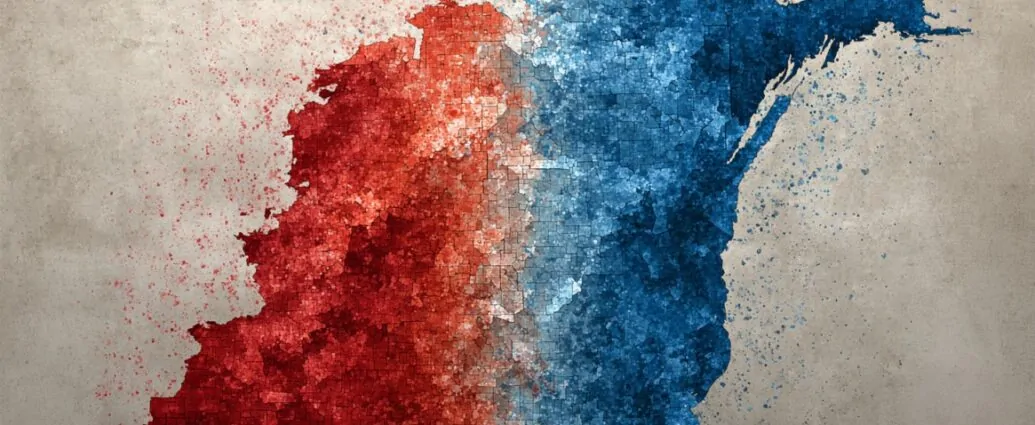
Indiana has carried a reputation as a Republican stronghold for decades, yet Democratic influence continues to persist in major urban centers such as Indianapolis and Gary.
Political alignment across the Hoosier state has never been fully uniform, and voting behavior often shifts sharply along urban and rural lines.
Year 2025 introduces an unusual mid-decade moment as redistricting returns to the agenda well ahead of the 2030 census. Redrawing congressional boundaries outside the normal cycle has placed Indiana at the center of a national power struggle.
Influence tied to President Trump and rising internal tension inside the Hoosier state legislature have turned Indiana into a contest over how political power is structured through district lines rather than a simple party fight.
Indiana’s Political Situation in 2025
Republicans currently control 7 of Indiana’s 9 seats in the U.S. House of Representatives, creating a strong numerical advantage at the federal level.
Control of statewide offices also remains firmly Republican, yet internal cohesion has weakened despite dominant margins.
- Seven congressional districts send Republicans to Washington
- Two districts remain under Democratic control, anchored in urban and industrial regions
- Supermajorities exist in both chambers of the Indiana General Assembly

Gov. Mike Braun has taken a cautious position regarding a special redistricting session. Public comments have emphasized fiscal responsibility, citing an estimated $150,000 taxpayer cost tied to convening lawmakers outside the normal calendar.
Legislative leadership has taken a sharper approach, framing redistricting as a strategic necessity rather than a budget concern.
House Speaker Todd Huston of Fishers and Senate President Pro Tempore Rod Bray of Martinsville traveled to meet directly with President Trump to coordinate redistricting strategy.
Discussions centered on reshaping congressional boundaries ahead of the 2026 midterm elections.
Party leaders have openly discussed a goal that reflects national ambitions.
- Creation of a 9-0 Republican congressional delegation
- Implementation ahead of the 2026 midterms rather than post-2030 census
- Alignment with national Republican timing and messaging
National Republican strategy linked to Trump’s influence now plays a central role in shaping decisions inside the Indiana Statehouse.
Federal priorities increasingly override local political balance, shifting focus away from community continuity toward partisan advantage.
Weaponization of the Map
Momentum behind redistricting in the Hoosier State accelerated after Texas Republicans used newly drawn congressional maps to solidify additional seats in Washington.
Democratic countermeasures in states such as California signaled that redistricting had shifted into an openly competitive national tactic rather than a routine census-driven process.
Indiana lawmakers chose participation over restraint, aligning state action with broader partisan escalation.
Political pressure tied to Trump-aligned figures played a decisive role. Calls to act quickly emphasized a closing national window that favors Republicans ahead of the 2026 midterms.
Redistricting in the Hoosier State moved away from administrative necessity and toward calculated electoral engineering designed to lock in advantages while conditions remain favorable.
Proposed Map and the Push Toward 9-0
Release of the proposed congressional map occurred on December 1, 2025, only days before a one-week fast-track legislative session. Compressed timing sharply reduced public scrutiny, limited testimony opportunities, and weakened organized resistance across civic groups and local governments.
Speaker Todd Huston openly stated that maximizing Republican seats served as the guiding principle. Structural choices embedded in the map reflect that admission across nearly every district line.
Indianapolis has been divided into four separate districts, each stretching deep into rural, Republican-heavy territory. Urban voting strength is diluted as dense city precincts are paired with distant counties that share little economic or demographic connection.
- Lake County and the existing 1st District are split apart
- New boundaries absorb communities such as Logansport, Peru, and Wabash
- Democratic-leaning populations are fragmented across multiple districts
A newly designed 7th District runs across northern Indianapolis and continues south to the Ohio River. Several districts now cover massive geographic areas, producing non-compact shapes that increase travel burdens and weaken constituent access.
Regional cohesion across the Hoosier State has been sacrificed in favor of partisan efficiency.
Republican leaders have defended these maps by referencing prior Democratic gerrymanders, particularly actions taken in Illinois during the 2021 redistricting cycle. Critics argue that comparison does not justify replicating similar tactics within Indiana.
Legal and Political Pushback
View this post on Instagram
Criticism followed immediately, centering on partisan intent and racial impact. Rep. Cherrish Pryor has stated that the district amounts to racial gerrymandering without ambiguity.
Rep. André Carson has condemned the division of Indiana’s largest city as unreasonable and disconnected.
Legislative countermeasures accompanied the map rollout. House Bill 1032 restructures how redistricting disputes move through the court system, reducing the ability of lower courts to intervene.
- County courts lose authority to issue injunctions
- Challenges are routed directly to the Indiana Supreme Court
- Temporary pauses on new maps are prohibited
Supporters argue these provisions protect voter confidence and election continuity. Opponents describe the legislation as insulation against accountability, limiting judicial review during critical early stages.
Legal action is widely expected. Groups such as Common Cause Indiana are preparing lawsuits, with racial gerrymandering positioned as the central legal argument tied to minority vote dilution across the Hoosier State.
Internal GOP Fractures and Civil Tensions
Republican unity has fractured as redistricting tactics intensify. Several GOP state senators have voiced concerns tied to ethics, public trust, and long-term voter backlash.
Opposition has carried severe consequences. Sen. Mike Bohacek and Sen. Jean Leising faced bomb threats and swatting incidents after breaking ranks with party leadership.
Leising has publicly stated she will not cave and plans to fight aggressively during the early session.
Legislative momentum increasingly reflects national party priorities rather than local agreement. Resentment inside Republican ranks continues to grow, revealing internal divisions that raw seat counts fail to show.
Public Sentiment and Voter Trends
@pbsnews Indiana’s Republican-led Senate voted Thursday afternoon against a plan to redraw its state’s electoral map.Twenty-one Republicans joined all 10 Democrats in voting down the measure. Outside the chamber, critics of the redistricting plan celebrated.The vote comes after months of pressure from President Donald Trump, who has been pushing Republican-led states to redraw their maps ahead of next year’s midterm elections. #pbsnewshour #newshour #pbsnews #indiana #politics #news ♬ original sound – pbsnews
Public reaction across the Hoosier State has been forceful and highly visible. Protests at the Statehouse have drawn hundreds of residents opposing the redistricting proposal.
Concerns differ by region yet converge around representation. Voters in Marion County and Southern Indiana object to being grouped with distant areas lacking shared economic interests or community identity.
Rep. Wendy Dant Chesser of Jeffersonville has warned that districts covering two major metropolitan areas create unavoidable conflicts, leaving constituents underserved regardless of party affiliation.
Growing public perception frames redistricting as election control rather than fair representation. Distrust now crosses party lines, fueling civic engagement and resistance efforts statewide.
Implications for 2026 and Beyond
Electoral analysis suggests strong Republican advantages under the proposed map. Democratic analyst Nick Roberts has noted that President Trump carried every newly drawn district by at least 12 points during the 2024 election.
- Closest Republican margin appears in the proposed 1st District
- Gov. Mike Braun won that district by 6 points
- Indianapolis-area districts project near 60-40 Republican splits
J. Miles Coleman of Sabato’s Crystal Ball has cautioned that a strong Democratic wave in 2026 could still flip vulnerable seats, including Rep. Frank Mrvan’s district. Other districts appear far less competitive due to newly drawn boundaries.
Long-term political consequences could reshape the Hoosier State. Calls for independent redistricting commissions may grow louder, while Democratic organizing in suburban and urban areas could accelerate as a direct response to perceived overreach.
View this post on Instagram
Summary
Indiana’s identity as a red state is being reinforced through aggressive redistricting strategies, yet resistance remains strong inside government institutions and among voters.
Court decisions, voter turnout, and upcoming elections will determine if the strategy locks in Republican dominance or sparks a sustained backlash.
Future outcomes may push Indiana further toward single-party control or ignite renewed competition across urban and suburban districts, marking 2025 as a decisive moment in state politics.