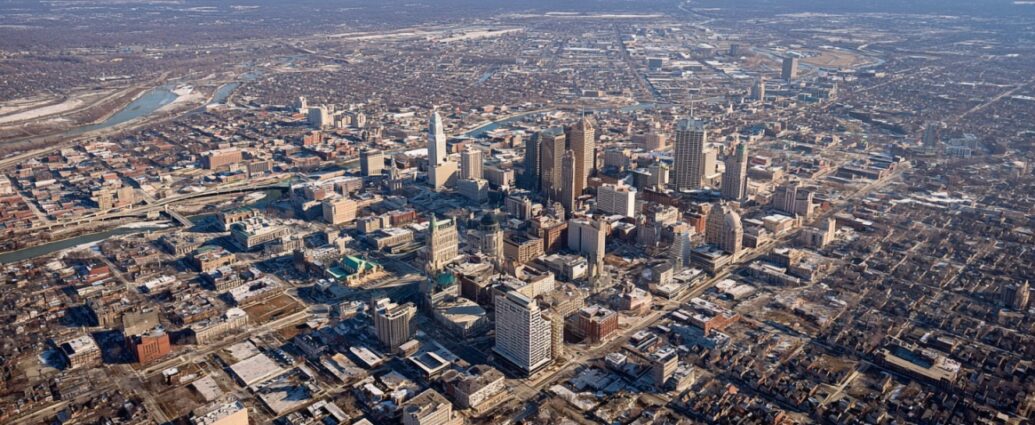
Indianapolis ranks as the largest city in Indiana and functions as the central hub of the Indianapolis metropolitan area. Metropolitan Indianapolis stretches across multiple counties in central Indiana and forms one of the largest economic and population centers in the state.
Recent census estimates show a noticeable pattern in regional population change.
At the same time, suburban counties surrounding Indianapolis have experienced stronger population increases.
Post-pandemic migration patterns across the United States help explain this shift. Many households have relocated away from dense urban neighborhoods and toward suburban communities offering newer housing, larger living spaces, and lower population density.
Indianapolis provides a clear example of a modern urban pattern in the United States.
Let’s talk about it.
Current Population Levels in Indianapolis
Indianapolis city, or the city balance used in Census estimates, reached 891,484 residents in 2024, compared with 887,213 in the 2020 Census.
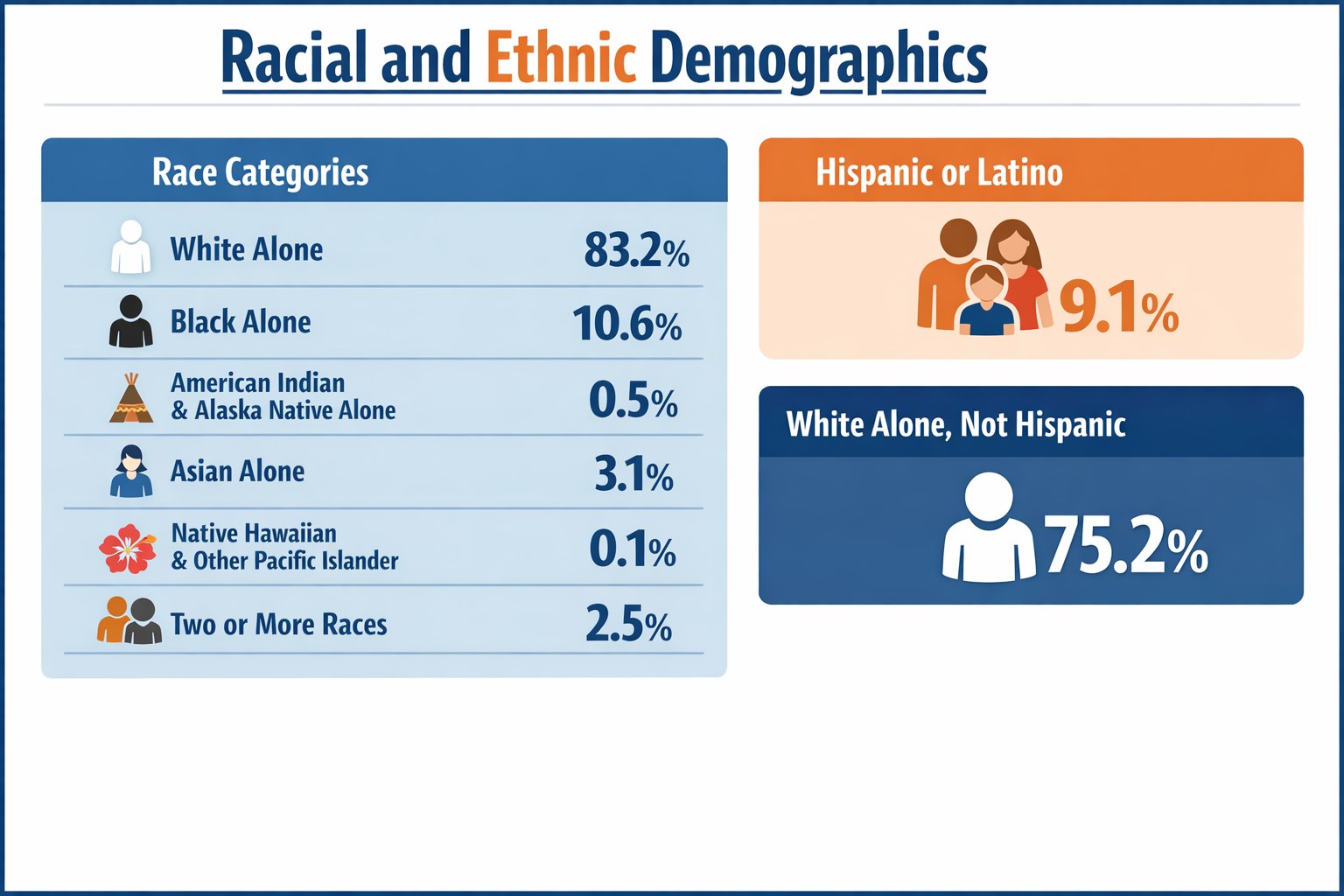
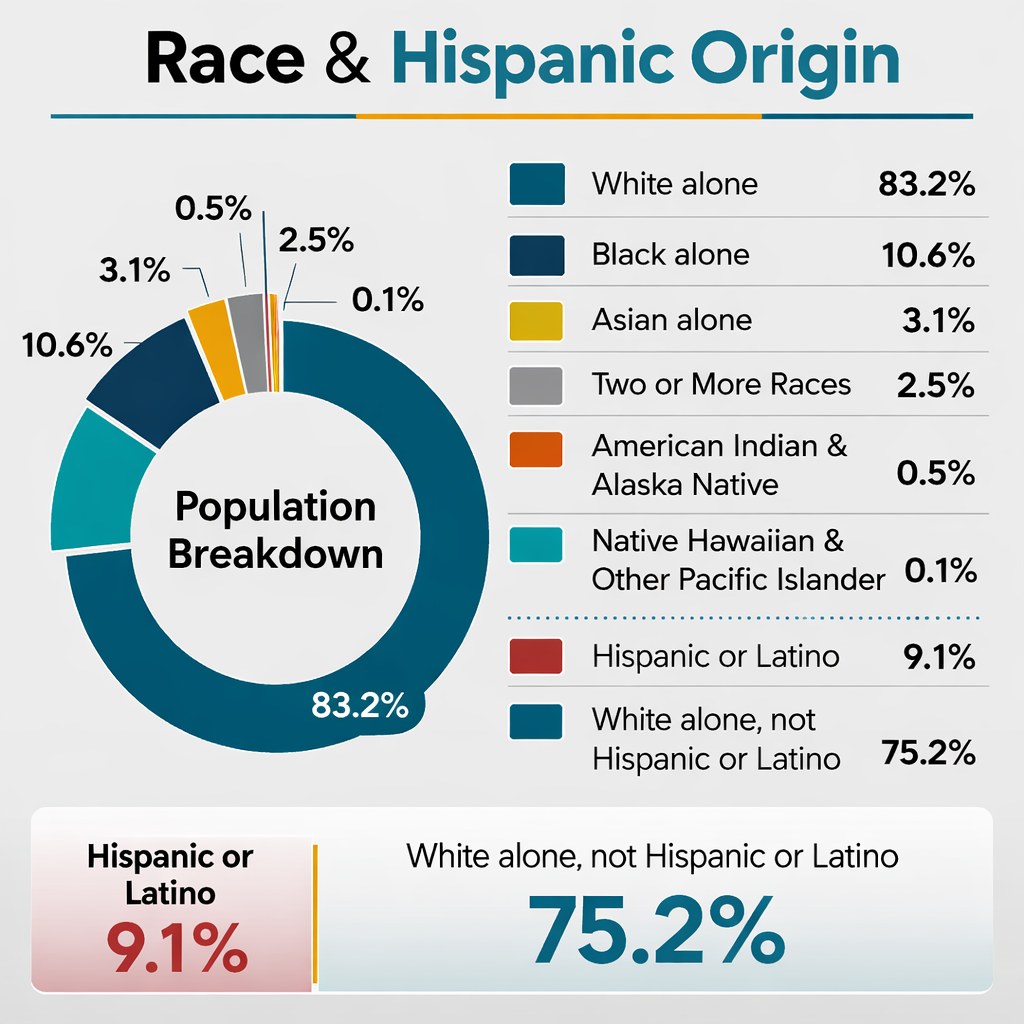
The demographics, based to race, look like this:
| Race and Hispanic Origin Category | % |
|---|---|
| White alone | 83.2% |
| Black alone | 10.6% |
| American Indian and Alaska Native alone | 0.5% |
| Asian alone | 3.1% |
| Native Hawaiian and Other Pacific Islander alone | 0.1% |
| Two or More Races | 2.5% |
| Hispanic or Latino | 9.1% |
| White alone, not Hispanic or Latino | 75.2% |
That equals a gain of 4,271 people, or about 0.5% over that period. Pace of growth has therefore remained slow for a city of its size, even though Indianapolis still holds its position as Indiana’s largest municipality.
Figure in your outline that places Indianapolis at 893,619 residents in 2026 fits the same broader pattern of limited city growth, though the latest widely available official city estimate I found is the 2024 figure above rather than a federal 2026 release.
Marion County adds another layer to the picture since the county’s population reached 981,628, up slightly compared with the 2020 Census count of 977,203.
That equals an increase of 4,922 residents, or 0.5%, which shows that county growth has also been modest across the first half of the decade.
Indianapolis continues to hold political, administrative, and economic weight in central Indiana, yet recent numbers show that city and county totals have moved far more slowly than those in many nearby suburban areas. That contrast sets up the larger metro pattern visible across the region.
The Metropolitan Area
Metro Indianapolis functions as a regional system rather than a single-city story. Commuting patterns, housing demand, and business activity tie Indianapolis to neighboring counties so closely that population change in one area often shapes outcomes across the others.
Indianapolis-Carmel-Greenwood metro area counted 2,143,859 residents in 2024, up from 2,058,839 in 2020. That equals a gain of 85,020 residents, or about 4.1% in four years.
Regional growth, therefore, moved much faster than city growth during the same period.
Metro structure also matters. STATS Indiana lists the metro area as including Boone, Hamilton, Hancock, Hendricks, Johnson, Madison, Marion, Morgan, and Shelby counties.
Population gains across these counties do not occur evenly, and recent estimates show that most momentum has occurred outside the central city.
Evidence of Metro Growth
Population trends across central Indiana show that metropolitan Indianapolis has expanded at a faster pace than the central city.
Regional growth since 2020 has occurred through a combination of suburban residential development, strong employment growth, and migration patterns that favor communities surrounding Indianapolis.
Metro data therefore show clear evidence that the broader Indianapolis region continues to add residents even as population growth inside city limits remains relatively slow.
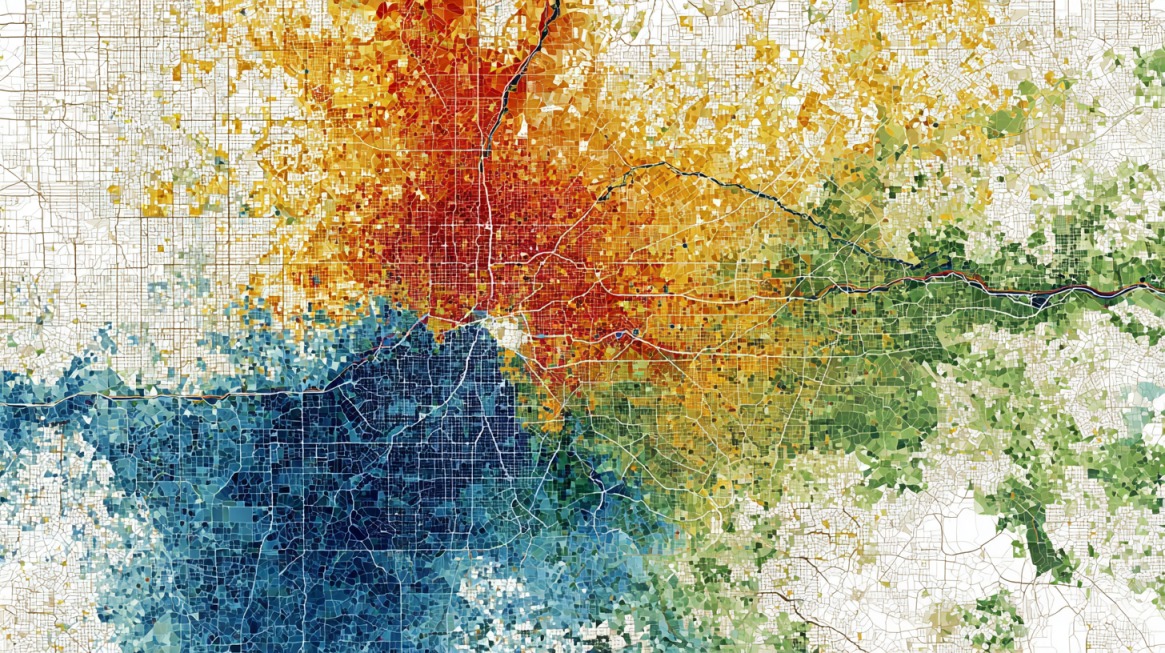
Suburban Expansion
Recent metro growth in central Indiana has leaned heavily toward suburban counties. City growth has been limited, but surrounding counties have added residents at a much quicker rate through new subdivisions, expanding local job bases, and continued in-migration.
County estimates show some of the clearest evidence:
| County | Population 2020 | Population 2024 | Numeric Growth | Growth |
|---|---|---|---|---|
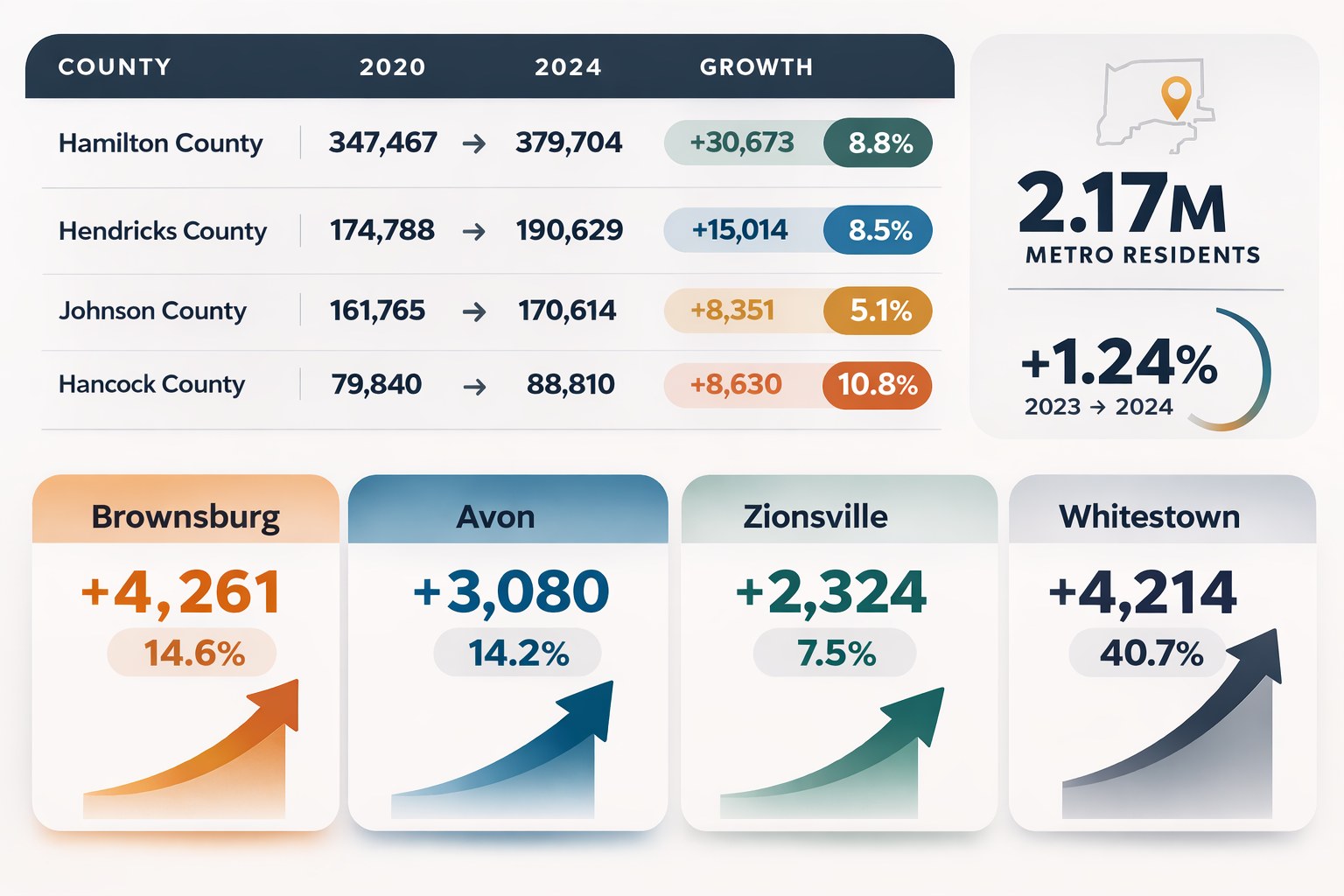
| Hamilton County | 347,467 | 379,704 | 30,673 | 8.8% |
| Hendricks County | 174,788 | 190,629 | 15,014 | 8.5% |
| Johnson County | 161,765 | 170,614 | 8,351 | 5.1% |
| Hancock County | 79,840 | 88,810 | 8,630 | 10.8% |
Metro growth has also outpaced the nation in recent years. Census reporting on metro areas showed that the U.S. metro population grew by about 1.1% between 2023 and 2024, while the Indianapolis metro added 26,661 residents in that same one-year span and posted a growth rate of 1.24%.
Daily Journal also reported that the Indianapolis metro area now has more than 2.17 million residents and ranks as the 33rd-largest metro area in the country.
Growth in suburban municipalities adds more evidence.
- Brownsburg rose by 4,261 residents, or 14.6%, between 2020 and 2024.
- Avon added 3,080 residents, or 14.2%, over the same period.
- Zionsville gained 2,324 residents, or 7.5%.
- Whitestown posted one of the most striking increases, adding 4,214 residents, or 40.7%.
Economic Drivers of Growth
Job growth across central Indiana has helped support metro expansion, especially in suburban counties where housing construction has kept pace with demand.
Indianapolis remains the region’s largest economic center, but employment growth has spread outward into:
- logistics corridors
- suburban office nodes
- life sciences clusters
- industrial parks
Indiana Business Review reporting for the Indianapolis area showed total nonfarm employment at 1,197,800 in August 2025, with year-over-year growth of 1.1%.
When you take a look at the different industries in the Indianapolis metro, it’ll be clearer about how real the growth is:
| Industry | Employment Aug 2024 | Employment Aug 2025 | Employment Share Aug 2025 | Growth 2024–2025 |
|---|---|---|---|---|
| Natural resources and mining | 700 | 700 | 0.1% | 0.0% |
| Construction | 69,100 | 70,000 | 5.8% | 1.3% |
| Durable goods manufacturing | 51,700 | 51,100 | 4.3% | -1.2% |
| Nondurable goods manufacturing | 45,300 | 47,300 | 3.9% | 4.4% |
| Wholesale trade | 55,900 | 56,600 | 4.7% | 1.3% |
| Retail trade | 99,700 | 100,100 | 8.4% | 0.4% |
| Transportation and warehousing | 87,100 | 89,600 | 7.5% | 2.9% |
| Utilities | 3,300 | 3,100 | 0.3% | -6.1% |
| Information | 11,600 | 11,000 | 0.9% | -5.2% |
| Financial activities | 75,300 | 75,000 | 6.3% | -0.4% |
| Professional and business services | 187,800 | 190,300 | 15.9% | 1.3% |
| Private educational services | 19,900 | 20,400 | 1.7% | 2.5% |
| Health care and social assistance | 165,300 | 172,400 | 14.4% | 4.3% |
| Leisure and hospitality | 115,200 | 113,100 | 9.4% | -1.8% |
| Other services | 50,900 | 49,200 | 4.1% | -3.3% |
| Government | 146,500 | 147,900 | 12.3% | 1.0% |
| Total nonfarm employment | 1,185,300 | 1,197,800 | 100.0% | 1.1% |
Source material for the region also identifies major employment concentrations in manufacturing, transportation and warehousing, professional and business services, and private education and health services.
Indiana’s economic development material identifies life sciences as one of the state’s strongest industry groups, while Indy Chamber regional material lists life sciences, technology, and related corporate employers as central parts of the Indianapolis regional economy.
Immigration as a Growth Factor
International migration has become one of the most important contributors to recent metro growth.
That pattern matches a national shift noted by the Census Bureau, which reported that international migration played a major role in metro population gains between 2023 and 2024.
Indianapolis metro data show the same trend in clear terms. The Indiana University report says that the metro area gained 44,144 new citizens in 2024, the largest number since 2008.
In practical terms, that means about half of the metro increase over that stretch came through foreign migration.
International migration has therefore played a major role in offsetting losses linked to the pandemic period and in sustaining labor-force growth across the broader metro economy.
Signs of Urban Decline in the Core City
Core-city decline in Indianapolis has not taken the form of dramatic collapse, yet city estimates do show a weaker trajectory than the surrounding region.
The gap between limited city growth and much faster suburban growth is one of the strongest themes in current population data.
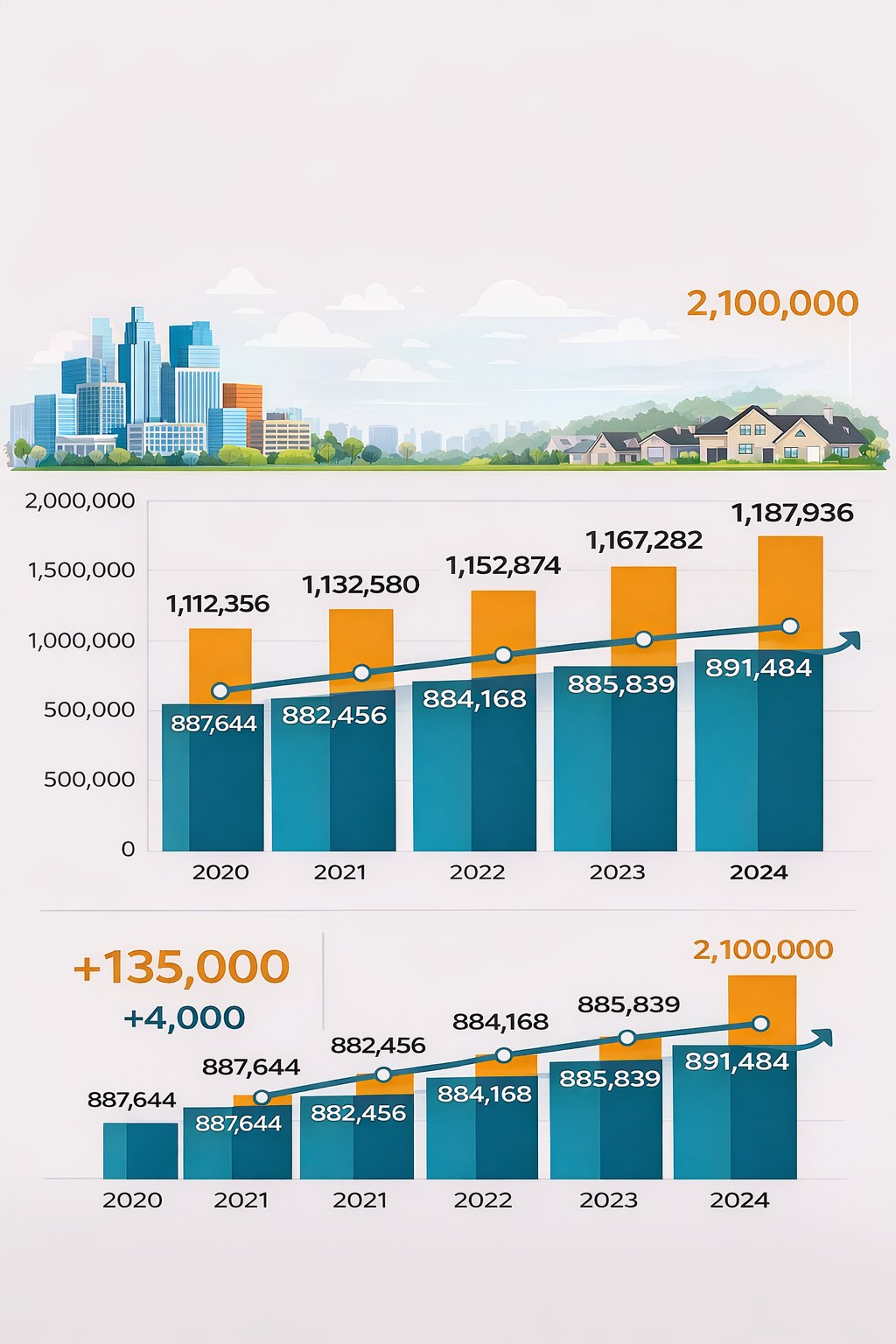
City estimates show that Indianapolis had 887,644 residents in 2020, then moved down to 882,456 in 2021 and 884,168 in 2022 before recovering to 885,839 in 2023 and 891,484 in 2024. Early-decade loss followed by only modest recovery helps explain why local analysis has described the city as lagging behind its suburbs even while the metro area expands.
Another way to see the divide is to compare city and metro rates over roughly the same period.
According to Axios, the Indianapolis metro grew 4.1% between 2020 and 2024, while the Indianapolis city balance grew only 0.5%. Stronger suburban gains therefore account for most regional momentum.
National migration patterns after the pandemic help explain this split. Census data show that metro areas overall are growing faster again, with international migration lifting many regions, yet local growth has often concentrated in suburbs and exurbs rather than downtown cores.
Demographic pressures add another constraint. As Fox59 states, Indiana recorded about 9,160 more births than deaths in 2024, marking the largest natural population increase recorded since 2020. However, it should be said that the main reason for the positive figures is immigration.
The Role of Suburbs in Regional Growth
Suburbs now account for a large share of population growth in central Indiana. Regional change has become increasingly concentrated in counties north, west, and south of Marion County, where land for new housing remains more available, and many communities continue to expand quickly.
Most important county gains since 2020 have occurred in places such as Hamilton, Hendricks, Hancock, and Johnson counties.
Boone County has also benefited from fast-growing towns such as Whitestown and Zionsville. Those areas have added residents through both countywide growth and strong municipal expansion.
- Whitestown – 10,350 in 2020 to 14,564 in 2024
- Brownsburg – 29,169 in 2020 to 33,430 in 2024
- Avon – 21,655 in 2020 to 24,735 in 2024
- Bargersville – 9,719 in 2020 to 11,283 in 2024
Housing supply plays an important role in that movement. Many suburban communities have had more room for subdivision construction, larger-lot housing, and newer residential inventory than the central city.
Local job nodes outside downtown Indianapolis have also expanded, especially in logistics and warehouse corridors, which makes suburban residence more practical for a larger share of workers.
Summary
Indianapolis demonstrates a metropolitan population pattern that appears in many parts of the United States. Suburban counties experience rapid population growth while central cities grow slowly or lose residents.
Population estimates and demographic data show continued expansion across the Indianapolis metropolitan area. City population growth remains limited compared with the growth occurring in surrounding counties.
Regional demographic change indicates that suburban expansion will remain a major factor shaping the future development of metropolitan Indianapolis.
Sources
- Census.gov – Indianapolis city (balance), Indiana
- StatsAmerica – Overview for Marion County, IN
- StatsIndiana – Indianapolis, IN Metro Area
- Daily Journal – IU analysis: Johnson County among Top 10 in state for population growth
- Indiana Business Review – Indianapolis forecast 2026
- Indiana University – Immigration fuels Indiana’s strong population growth in 2024
- Axios – Indianapolis suburbs drive metro area growth
- Fox59 – Indiana’s large population growth is fueled by migration
- Business Insider – Every US state’s fastest-growing small town you’ve never heard of
- WishTV – Petition seeks to change Brownsburg from a town to a city