
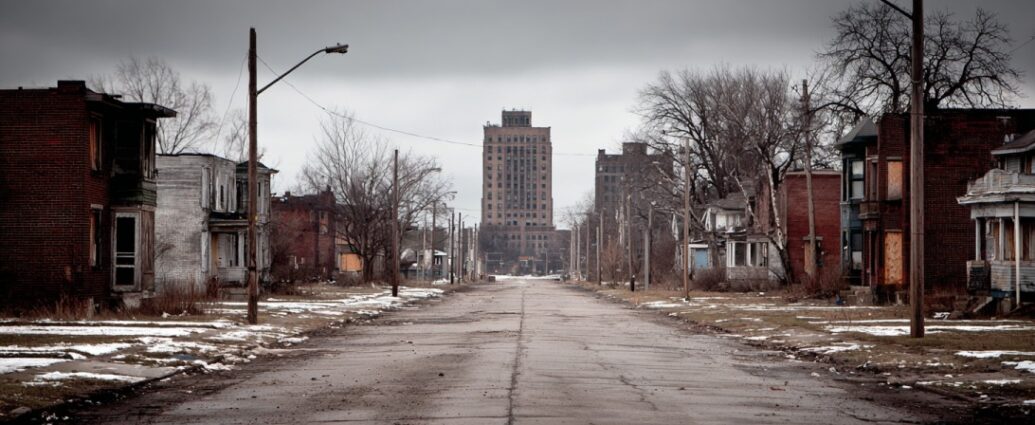
Gary, Indiana, has carried a reputation for crime and danger for decades. News coverage, documentaries, and word of mouth have painted a picture of high homicide rates, abandoned buildings, and long-term economic decline.
Many Americans still associate the city with some of the worst crime statistics in the Midwest.
Perception, however, does not always keep pace with current data. Crime levels shift over time, policing strategies change, and communities adapt.
In 2026, an important question remains: does the data still support Gary’s long-standing reputation, or has reality shifted in meaningful ways?
Answer requires looking closely at crime statistics, recent trends, and comparisons within Indianapolis and the rest of the state.
What the Numbers Say About Current Crime in 2026?
Recent figures show that crime in Gary remains significantly higher than national averages, reinforcing long-standing safety concerns. Nextdoor’s crime overview reports approximately 59.75 crimes per 1,000 residents, compared to a national average of 33.37 per 1,000.
A gap of more than 26 incidents per 1,000 residents places Gary well above that benchmark and keeps it in conversations about high-crime cities.
- Violent crime rate sits at 31.73 per 1,000 residents.
- Property crime rate stands at 28.02 per 1,000 residents.
Combined, those figures create a statistical profile that supports the city’s tough reputation. Violent offenses alone occur at a rate that exceeds what many Americans consider normal for a city of Gary’s size.
Additional estimates reinforce that picture. NeighborhoodScout calculates that roughly 1 in 118 residents may become a victim of violent or property crime. FBI-based figures cited through HomeSnacks estimate a violent crime rate of around 898 per 100,000 residents, approximately 150% higher than the national average.
Property crime also remains above both Indiana and national averages, keeping overall crime levels elevated in per capita comparisons.
Numbers like these confirm that risk levels in Gary are higher than in many American cities. At the same time, citywide averages can mask important details. Crime is not evenly distributed across neighborhoods, and year-to-year trends matter just as much as static rankings.
How Does it Affect the Local Population?
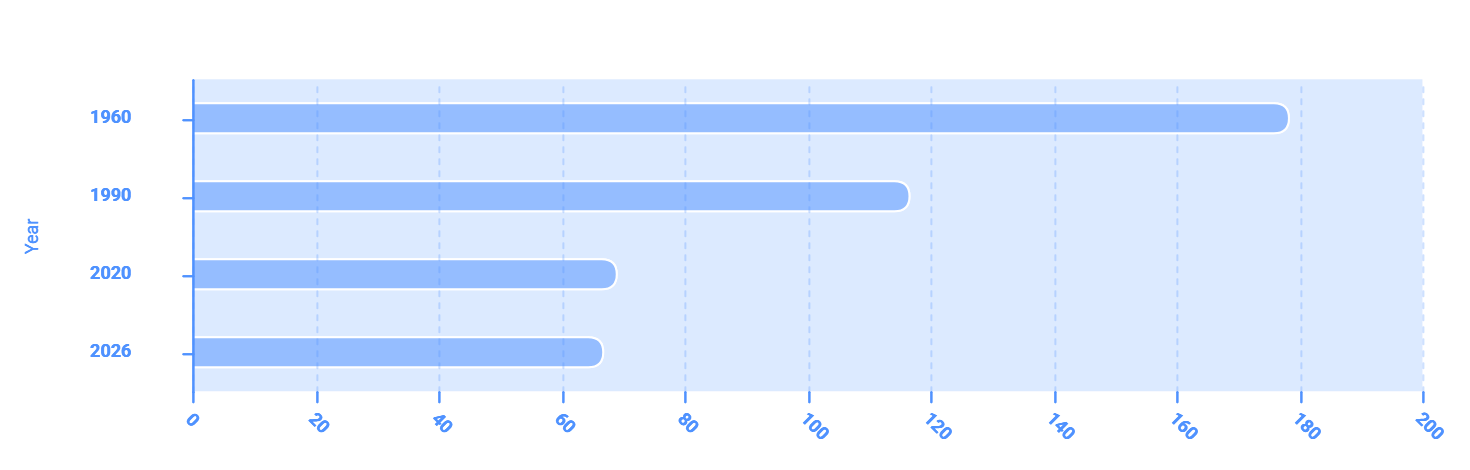
The sharp decline of Gary’s population shows precisely the consequences of the overall decline this city has experienced in the last couple of decades.
According to WorldPopulationReview, the population of the city from 1960 to today looks like this:
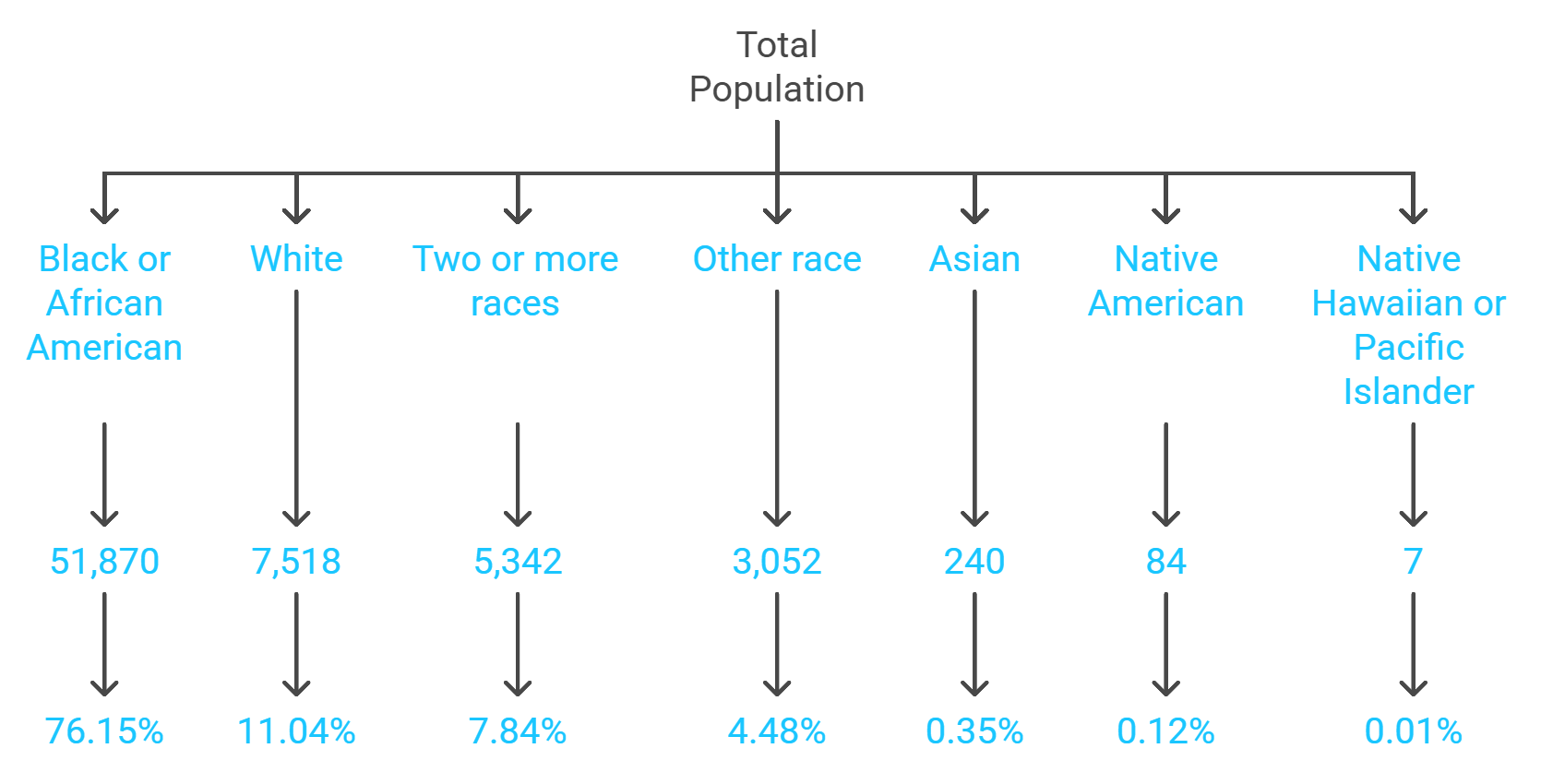
At the same time, the local demographics look like this:
Naturally, the unstable situation translates to an economic environment that makes Gary significantly less desirable compared to many cities in the country.
- Average Income – $36,142
- Median Household Income – $38,731
- Poverty Rate – 33.13%
2025 to 2026 Crime Trends
- Non-fatal shootings decreased 22.8%, dropping from 123 incidents to 95.
- Homicides declined 36.8%, falling from 38 to 24.
- A total of 24 homicides in 2025 marked the lowest annual number recorded since at least 1970.
Law enforcement activity increased during that period. Authorities seized 369 firearms in 2025, representing a 41.4% increase compared to the previous year. Federal prosecutions of violent offenders rose by 25%.
A Homicide Task Force formed in 2023 contributed to higher clearance and conviction rates. Multi-agency collaboration has focused on repeat violent offenders and illegal firearms. Data suggests that targeted enforcement efforts correspond with measurable declines in shootings and homicides.
Violent crime remains high in per capita terms, yet trend lines show meaningful improvement.
Comparisons With Other Indiana Cities

Statewide comparisons complicate the narrative that Gary automatically ranks as Indiana’s most dangerous city. Recent reporting identified South Bend, not Gary, as the most dangerous city in certain crime analyses.
Per capita figures still place Gary near the top in violent crime categories, but it no longer holds a consistent number one position across every ranking.
Variation in rankings often depends on how the data is calculated. Some reports weigh violent crime more heavily than property crime. Others factor in population size or recent trend lines. Minor methodological differences can significantly shift results, especially in cities with smaller populations.
Context within Indiana matters. Gary remains among the higher-crime cities in the state, yet it does not dominate every list as it once did. Shifts in homicide totals and shooting declines have affected its relative position.
Of course, it is good to see that the locals are making an effort to make the city a better place to live. Those who remember Gary from the 90s know that it was known as “Murder Capital.
Law Enforcement and Policy Efforts
Efforts to reduce violence have relied on coordinated action among multiple agencies. The Gary Police Department has worked closely with the ATF, the U.S. Attorney’s Office, and the Lake County Prosecutor’s Office to focus on repeat offenders and illegal gun activity.
- 369 firearms were seized in 2025, a 41.4% increase year over year.
- Federal prosecutions of violent offenders increased by 25%.
Homicide Task Force, we’ve mentioned previously, improved clearance and conviction rates, increasing accountability for serious crimes. Data-driven policing methods target hot spots and individuals linked to a disproportionate share of violence.
Parallel movement of stronger enforcement and falling homicide numbers suggests a correlation between focused policing and measurable declines.
Gary still faces crime rates higher than state and national averages, yet a sustained reduction in lethal violence points to change that is both quantifiable and recent.

Public Perception vs. Reality
National perception of Gary has been shaped by decades of reporting on economic decline and visible abandonment.
Online publications and travel blogs frequently point to rows of vacant buildings and deteriorating infrastructure. Urban explorer videos often focus on empty schools, churches, and homes, reinforcing an image of a city frozen in hardship.
Such portrayals strongly influence how outsiders think about safety in Gary. Visual imagery of decay can leave a lasting impression, sometimes overshadowing statistical nuance or recent progress.
Residents often describe a more complex picture. Community pride is visible in neighborhood cleanups, murals, and local initiatives aimed at youth engagement and crime prevention. Daily life for many families involves work, school, church, and community events similar to those in other Midwestern cities.
Safety varies by neighborhood. Some areas experience far lower crime rates than citywide averages suggest. Concentration of violent incidents in specific sections of the city can skew overall statistics.
Despite the decline in overall crime, it is interesting to note the expenses of the local crime in Gary, Indiana, for 2025, according to CrimeGrade:
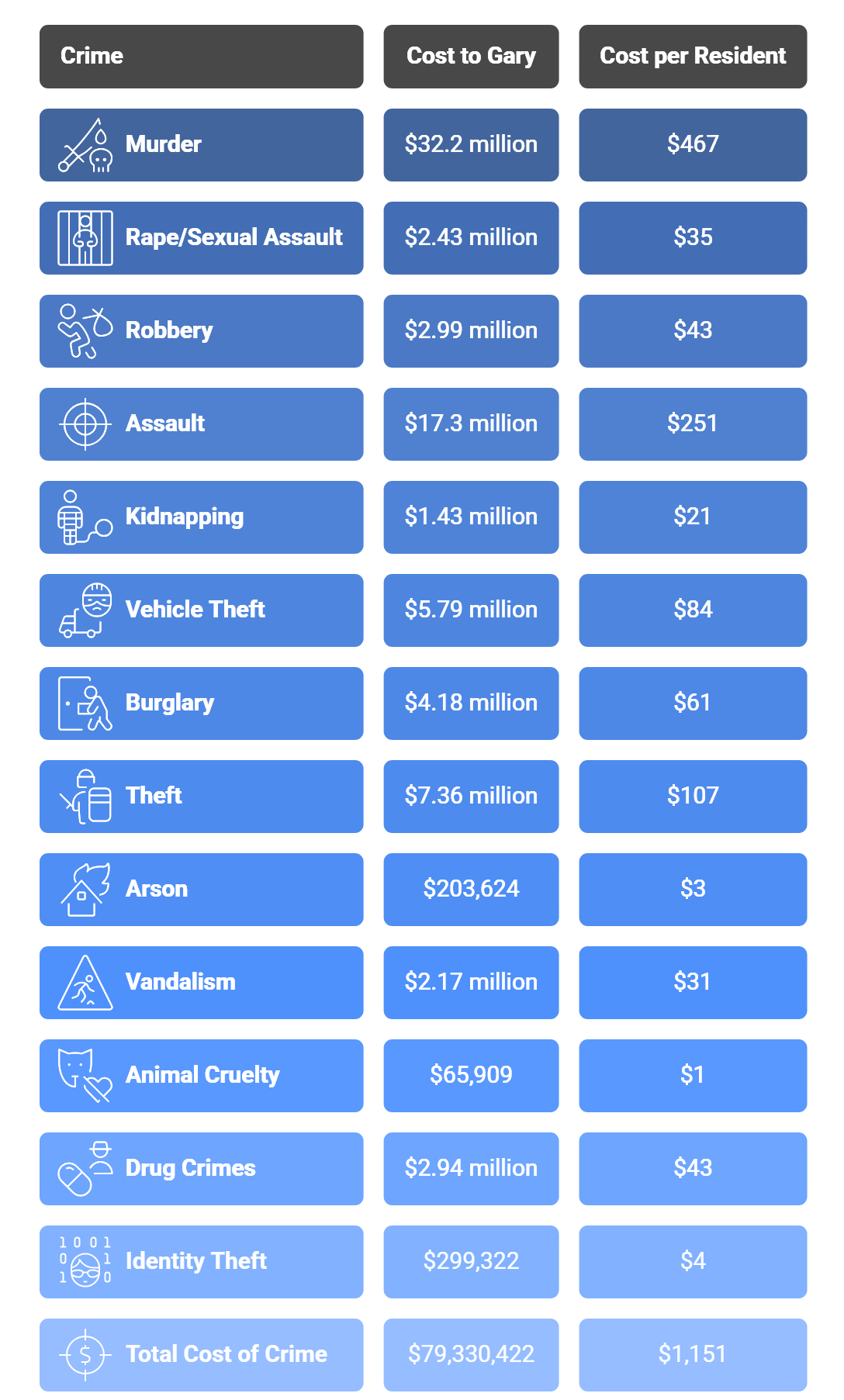
It is even more interesting to see how Gary compares to other cities in the state, the state level, and the national level, in this regard:
| Location | Cost per Resident |
|---|---|
| Gary, IN | $1,151 |
| Notre Dame, IN | $1,359 |
| Roanoke, IN | $181 |
| Indiana | $402 |
| USA | $464 |
Improvements in policing partnerships and data-focused enforcement suggest measurable progress. Declines in shootings and homicides provide evidence that efforts are producing results.
So, Is Gary Really That Dangerous in 2026?
@thesignpicker Are YOUR neighbors watching YOU?? The City of Gary, Indiana, protected by neighborhood watch, communicated a stern warning via this sign sponsored by the Gary Police Department, the Mayor and funded by the the Indiana Criminal Justice Institute and Lake County Crime Prevention Program. And now, Gary may be the future home of the Chicago Bears!! #gary #indiana #crime #sign #collection #fyp ♬ Funky Lo-fi Vides (P-funk Jazz) – Gazelle
Crime rates in Gary remain statistically higher than both state and national averages. Approximately 59.75 crimes per 1,000 residents, along with a violent crime rate of 31.73 per 1,000, place the city above U.S. norms. FBI-based estimates of around 898 violent crimes per 100,000 residents reinforce that reality.
At the same time, trend data shows clear improvement. Non-fatal shootings declined by 22.8%. Homicides dropped by 36.8%, reaching 24 in 2025, the lowest total recorded since at least 1970. Firearm seizures and federal prosecutions increased significantly, suggesting stronger enforcement.
Gary is no longer consistently ranked as Indiana’s most dangerous city, and public perception often reflects older data and powerful imagery rather than current trends.
Fun fact: Did you know that Michael Jackson grew up in Gary, Indiana?
Sources
- WorldPopulationReview – Gary Population
- NextDoor – Gary, IN crime rates and safety statistics
- NeighborhoodScout – Gary, IN Crime Rates
- Homesnacks – Gary, IN Demographics And Statistics
- Gary.gov – Gary Police Department, ATF, and U.S. Attorney’s Office Announce Significant Drop in Violent Crime
- ChicagoCrusader – Gary counts successes from partnership with Indiana State Police
- NY Times – Crime Statistics South Bend and St. Louis Misleading
- LA Times – Gary Fights ‘Murder Capital’ Tag : Urban renewal: Indiana community once was a livable city; its people are struggling to make it so again.
- Wish TV – Violent Crime Decline in Gary
- El Pais – Gary Stevenson: ‘Economists have been all wrong about almost everything for 15 years now’
- CrimeGrade – The Safest and Most Dangerous Places in Gary, IN: Crime Maps and Statistics